

ISO 14001:2026 was published on 21 April 2026 — this week. We went straight to Annex A — the part most people skip on first read because it is labelled “informative”. That is a mistake. For experienced auditors and certification bodies, Annex A is the first reference when interpreting disputed requirements. Knowing it means you can have that conversation on equal terms.
This article is for QMRs and environmental managers who already know ISO 14001 and want a precise, clause-by-clause comparison of the Annex A changes between the 2015 and 2026 editions. No background theory — just the differences and their practical implications.
For a general overview of all ISO 14001:2026 changes, transition timelines, and first steps, see our introductory article on ISO 14001:2026.
Why Annex A matters for practitioners
Annex A is informative, not normative. It adds no new requirements — but it explains how the standard’s authors intended the requirements to be understood. In practice, when an auditor interprets a requirement differently from how your system implements it, Annex A is the argument that counts. Knowing it lets you resolve misunderstandings before the audit, not during it.
ISO 14001:2026 has significantly revised Annex A — not just linguistically, but structurally and substantively. Some sections are entirely new, others have been merged or expanded. If you know the 2015 version and are looking only for the differences, this is the direct comparison.
Structural changes at a glance
| Section | 2015 | 2026 | Type of change |
|---|---|---|---|
| A.1 | Contained change management | Shortened, refers to A.6.3 | Restructured |
| A.3 | Basic terminology | Extended terminology | Content expansion |
| A.4.1 | Context — general | + Ecosystems, biodiversity | Significant expansion |
| A.6.1.1 | Contained risks and opportunities | Moved to A.6.1.4 | Restructured |
| A.6.1.4 | Did not exist | New section: Risks & opportunities | Entirely new |
| A.6.1.5 | A.6.1.4 Planning action | Extended action planning | Renumbered + expanded |
| A.6.3 | Did not exist | New section: Planning of changes | Entirely new |
| A.7.4 | Communication — general | + Timeliness, sustainability reporting | Significant expansion |
| A.9.2 | Internal audit | + External audits as input | Content expansion |
A.1 General — Change management becomes standalone
In the 2015 edition, A.1 was the central section for change management. It contained a detailed description of which types of changes affect the EMS, and all other sections referred back to it with “see Clause A.1”.
In the 2026 edition, A.1 has been significantly shortened. Change management has been moved to a new standalone section: A.6.3 “Planning of Changes”. All previous references to “Clause A.1” have been replaced with “see A.6.3”.
This is more than a structural edit: change management is now positioned as a planning task, not a general system maintenance topic. The signal to practitioners — and auditors — is clear.
A.3 Clarification of concepts — new terminology with consequences
A.3 matters most to auditors because terms defined here, if misused, can generate findings. The 2026 edition adds several important clarifications.
| Topic | 2015 wording | 2026 wording | Practical relevance |
|---|---|---|---|
| Outcome vs. Result | Not explicitly distinguished | Outcome = strategic intent; Result = measurable achievement | Objective tracking, management review |
| Determine | Formal designation | Discovery process leading to knowledge | All “determine” requirements |
| Documentation | “Maintain documented information” | “Shall be available as documented information” | Document control |
| Compliance | “Fulfil compliance obligations” | “Meet compliance obligations” | Audit language |
| Outsourcing | “Outsourced processes” | “Externally provided processes, products or services” | Supplier management |
| Risk terminology | Standalone “risk” definition | Only “risks and opportunities” as defined term | Risk assessment |
“Outcome” versus “result”: The 2026 edition explicitly distinguishes between these two terms. “Outcome” refers to strategic intent — what the organisation intends to achieve with its EMS. “Result” refers to a measurable achievement already attained. For management review and objective tracking, this distinction is operationally relevant: an environmental objective is an “outcome”; its measured achievement is a “result”.
“Determine” as a discovery process: The 2026 edition explicitly states that “determine” describes a discovery process that leads to knowledge — not merely a formal designation. This applies to every clause where the organisation must “determine” something.
New documented information terminology: Two phrasing changes have direct implications for document control:
- “Maintain documented information” (documentation) has been replaced by “shall be available as documented information”
- “Retain documented information as evidence of” (records) has been replaced by “documented information shall be available as evidence of”
“Available” means the organisation can obtain, use, or provide the information. This is a clarification, not a tightening — but auditors will apply the new terminology when reviewing documentation.
Terminology harmonisation: “Outsourced processes” has been replaced throughout by “externally provided processes, products or services”, consistent with the main standard. The standalone definition of “risk” has been removed — only “risks and opportunities” remains as a defined term. “Fulfil compliance obligations” has been replaced by “meet compliance obligations” to align with ISO language requirements.
A.4.1 Context of the organisation — ecosystems and biodiversity as new substantive topics
This is one of the most significant content expansions in the entire annex. A.4.1 has been substantially extended in the 2026 edition.

New is the explicit inclusion of ecosystem health and biodiversity as relevant environmental conditions. The 2015 edition mentioned biodiversity only as one example among many. The 2026 edition includes a standalone definition:
Ecosystem health refers to the overall condition or integrity of an ecosystem and its ability to maintain structure, function and resilience over time.
There is also a new paragraph on the interconnection of environmental conditions: climate interacts with other environmental conditions. Organisations that document only climate actions but do not address biodiversity loss, resource depletion, or ecosystem instability may face audit findings on gaps.
Practically relevant: the bibliography now includes two new standards — ISO 17298 (biodiversity in strategy and operations) and ISO 59014 (circular economy, secondary materials). Depending on your sector and environmental footprint, these may be worth reviewing for your next environmental aspects update.
A.4.2 Interested parties — climate change is not the whole picture
In the 2015 edition, many organisations’ interested party analyses implicitly focused on climate action. The 2026 edition sends an explicit signal against that narrowing:
Alongside climate change, pollution levels, resource depletion, biodiversity loss, and ecosystem instability are now expressly named as equally valid topics in interested party requirements. Auditors will no longer focus exclusively on climate measures — they will ask whether the organisation has also considered the other planetary challenges in its stakeholder analysis.
A.4.3 Scope — corporate structures and transparency
New in the 2026 edition is an explicit reference to organisations that rely on external entities — for example, a corporate head office — for key functions such as resource allocation or decision-making. These dependencies must be considered when defining scope.
The clarification that the scope statement must be “factual and representative” and must not omit relevant information is more precisely worded than in the 2015 edition. Scope definitions that visibly exclude areas with significant environmental aspects remain impermissible — but the language is now sharper.
A.5.1 Leadership — trust through visible action
A new sentence in A.5.1 makes clear that top management can demonstrate leadership and build trust with interested parties through concrete action on environmental and sustainability issues. This adds no new obligation, but it is a clear signal for communication strategy: visible engagement from senior leadership is part of the EMS — not just a signature on the environmental policy.
A.5.2 Environmental policy — natural resource protection explicitly elevated
The 2026 edition adds explicit mention of “natural resource preservation or conservation” to the examples of environmental protection commitments — alongside climate action, biodiversity, ecosystem protection, and restoration.
For environmental policy reviews: a policy limited to emissions reduction will face closer questioning about its scope going forward.
A.6.1.1 General — streamlined by relocation
In the 2015 edition, A.6.1.1 contained a detailed description of risks and opportunities including example lists. In the 2026 edition, this content has been moved entirely to the new standalone section A.6.1.4. A.6.1.1 remains as a general planning framework — leaner and more clearly structured.
A.6.1.2 Environmental aspects — land use, marine areas, revised emergency structure
Two content changes are practically relevant here.
New environmental aspect categories: The example list has been expanded. The previous item h “use of space” has been replaced by:
- h) Land use
- i) Use of marine and coastal areas
For manufacturing organisations without a coastal or maritime footprint, little changes. For port operators, fishing companies, maritime industries, or organisations with significant land consumption, these categories require explicit review.
Emergency situations now anchored in A.6.1.2: In the 2015 edition, determining emergency situations was part of A.6.1.1. In the 2026 edition, it belongs to A.6.1.2 — the environmental aspects section. This is logically consistent: emergency situations are first to be considered through the lens of environmental aspect determination.
“Abnormal operating conditions” receive a new definition: rare, atypical, unplanned — and: they can introduce new environmental aspects or change existing ones. This is a direct prompt to ensure your environmental aspects process is complete not only for normal operations but also for non-standard operating states.
A.6.1.4 Risks and opportunities — entirely new standalone section
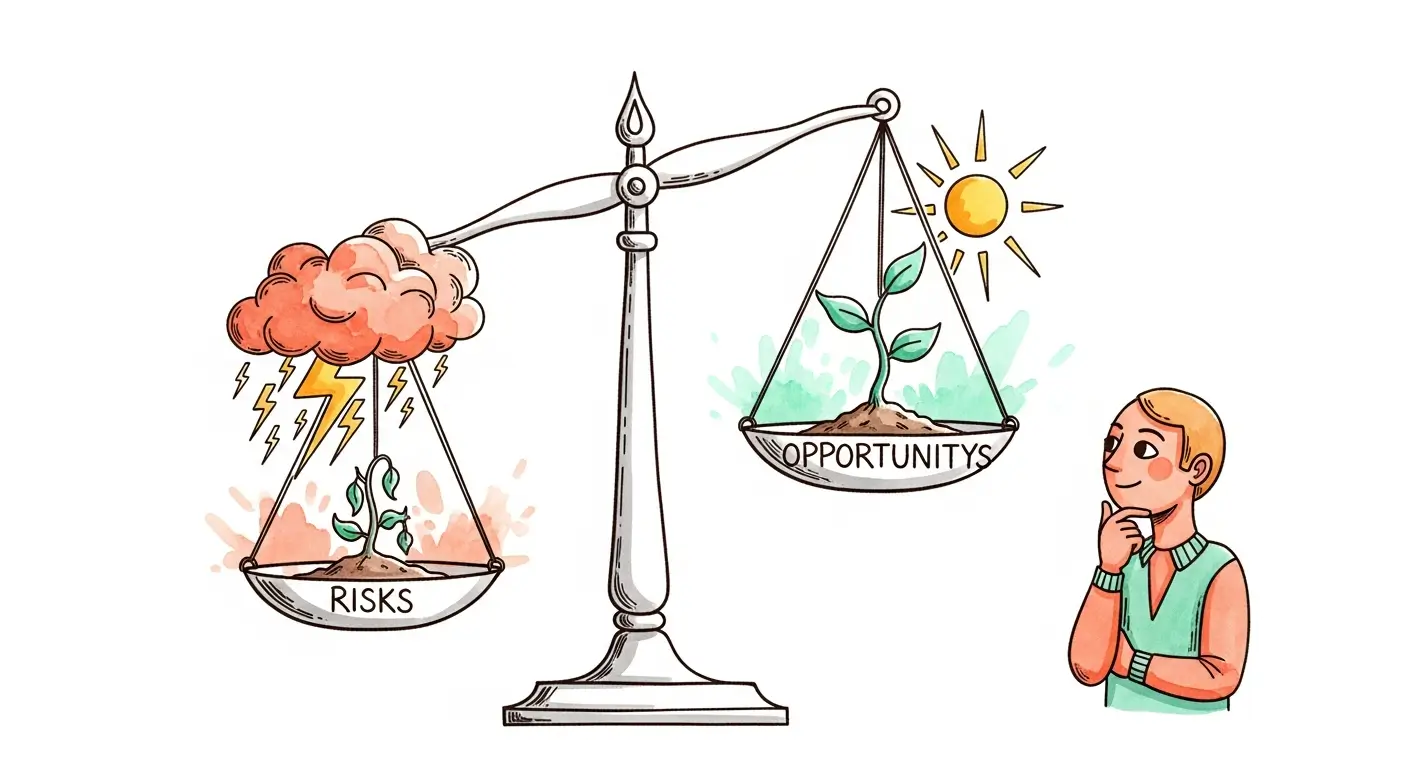
This is the largest structural change in the planning section of the annex: risks and opportunities now have their own standalone section in the 2026 edition — A.6.1.4 is entirely new.
| Opportunities (A.6.1.4) | Risks (A.6.1.4) |
|---|---|
| Transition to circular economy — waste minimisation and resource efficiency | Language or literacy barriers as incident causes |
| Improved land management to enhance biodiversity | Climate change impacts: flooding, drought, extreme temperatures, wildfires |
| Employee engagement and training for environmental goals | Insufficient resources for an effective EMS |
| Advanced analytics and real-time data for sustainability decisions | Water scarcity disabling emission control equipment |
| Partnerships with environmental organisations and suppliers | Supply chain disruptions and resource scarcity |
| Proactive adoption of emerging environmental regulations | Long-term impacts of biodiversity loss on operations |
| New technologies through government grant programmes | Reputational damage and legal consequences from non-compliance |
In practice: this example list is the de-facto audit framework for risk and opportunity assessments. If your risk assessment does not include circular economy, biodiversity, and climate change impacts — at minimum as explicitly considered and justifiably excluded topics — that is a potential finding.
For methodological background on risk and opportunity management in management systems, see our article on risk-based thinking.
A.6.1.5 Planning action — integration into business processes
What was “Planning action” under A.6.1.4 in the 2015 edition is now A.6.1.5 — and has been expanded. New is the explicit specification of how actions should be integrated into business processes:
- Environmental requirements into design and development processes
- Environmental requirements into procurement and purchasing processes
- Competence requirements into HR processes
- End-of-life and disposal requirements into sales and marketing processes
Energy management systems, occupational health and safety systems, and other IMS components are explicitly named as potential parallel structures for shared actions.
A.6.2 Environmental objectives — small wording change, real audit relevance
The 2026 edition adds a new statement: it is important that the organisation is able to determine whether an environmental objective has been achieved — not just ensure it. This phrasing shift is small but auditorially relevant: an environmental objective without a determinable fulfilment criterion is insufficient under the new logic.
A.6.3 Planning of changes — new standalone section (entirely new)
This is the most significant structural intervention in the entire annex. What was part of A.1 in the 2015 edition now has its own standalone section under Planning: A.6.3 “Planning of Changes”.

| No. | Change trigger per A.6.3 | Status |
|---|---|---|
| 1 | New or modified products, services, processes, operations, equipment or facilities | Carried over |
| 2 | Changes to compliance obligations | Carried over |
| 3 | New knowledge about environmental aspects, impacts, risks or opportunities | Carried over |
| 4 | Developments in knowledge and technology | Carried over |
| 5 | Changes to technical specifications of materials or process inputs | Expanded |
| 6 | Changes in business assets due to mergers, acquisitions, joint ventures or divestitures | New |
| 7 | Changes in staff or external providers, including contractors | Expanded |
| 8 | Business disruption due to supply chain issues, labour disputes, natural disasters, political unrest or war | New |
There is also an explicit requirement: the organisation must review the consequences of unintended changes and take action to mitigate adverse effects where necessary.
And a NOTE with audit relevance: Changes can result in risks and opportunities. This is the bridge connecting the change management process to the risks and opportunities process under A.6.1.4.
For practice: does your existing EMS have a documented change management process? Does it cover all eight categories — including M&A activity and geopolitical business disruptions? This will be a standard topic in surveillance audits going forward.
A.7.4 Communication — timeliness and sustainability reporting
A.7.4 has been significantly expanded in the 2026 edition to reflect the growing importance of external environmental and sustainability communication.
New is the explicit acknowledgement that external communication requirements on environmental and sustainability information are increasing — both mandatory (e.g. regulatory reporting) and voluntary. Specifically named for the first time: communication on products and services (resource efficiency, water footprint) and supply chain communication with suppliers and customers.
Relevant for organisations subject to CSRD, ESRS, or supply chain due diligence legislation: ISO 14001:2026 now provides an explicit framework for these communication obligations.
The list of communication requirements has also gained a new criterion: “timely”. Organisations that do not communicate environmental incidents, compliance information, or performance data promptly can be measured against this standard.
A.9.1.2 Evaluation of compliance — external assessments and revised terminology
Two clarifications have been added in the 2026 edition:
- The organisation may use the results of compliance evaluations conducted by external parties as part of its own compliance evaluation process — previously implicit, now explicitly confirmed.
- The frequency and timing of compliance evaluations depend on the importance of the requirement, operating condition variations, changes to compliance obligations, and past performance — more precise than the 2015 formulation.
Terminologically: “failure to fulfil a legal requirement” has been replaced by “failure to meet a compliance obligation”, consistent with the revised main standard language.
A.9.2 Internal audit — audit evidence and previous findings
A.9.2 now opens with a new paragraph defining audit evidence and audit criteria — a conceptual addition relevant to audit planning and documentation.
More practically relevant: when considering results of previous audits, external audits are now explicitly included — not only internal ones. This matters particularly for organisations that regularly undergo customer or certification audits.
Our article on internal audits and systematic preparation provides complementary methodology that applies equally to the EMS context.
A.9.3 Management review — structure and time for decisions
The 2026 edition reorders the content of A.9.3: the definitions of “suitability”, “adequacy” and “effectiveness” now appear at the end of the section rather than the beginning — logically stronger as evaluative benchmarks after the substantive description.
A new clarification states that the management review must allow for appropriate and adequate time intervals so that decisions can be implemented effectively and in a timely manner. This is a direct pointer to the common practical error of treating management review as a formality without resulting actions with deadlines and owners.
A.10.1 Continual improvement — external audits as improvement input
The 2015 edition named internal audits as the basis for improvement actions. The 2026 edition explicitly adds external audits as an information source for continual improvement. For organisations with active customer or supplier audit programmes, this is an explicit invitation to systematically integrate external findings into improvement governance.
What this means for your practice — action items

- Review your change management process: Is there a documented process covering all eight trigger categories per A.6.3 — including M&A activity and geopolitical disruptions? Is it linked to the risk assessment process?
- Update your risk and opportunity assessment: Does it include circular economy, biodiversity loss, climate change impacts, and resource scarcity? These new examples in A.6.1.4 are a direct audit signal — not as mandatory topics, but as topics that must have been assessed and reasoning documented.
- Extend your context analysis: Has ecosystem health been considered in the context analysis per clause 4.1? Are biodiversity loss and resource depletion reviewed as potential environmental conditions?
- Check your environmental aspects determination: Are the new categories of land use and use of marine and coastal areas (items h and i per A.6.1.2) relevant to your organisation? If so, have they been determined and evaluated?
- Review communication for timeliness: Are there defined timelines for external environmental communications? Does the process address the growing requirements from CSRD, supply chain due diligence legislation, and similar frameworks?
- Check the relevance of ISO 17298 and ISO 59014: Depending on your sector and environmental footprint, these new standards in the ISO 14001:2026 bibliography may provide useful guidance for biodiversity and circular economy topics.
Frequently asked questions about the Annex A changes
Is Annex A normative or informative — and what does that mean for audits?
Annex A is informative. It adds no new requirements and cannot be cited as a standalone audit reference. In practice, however, experienced auditors use Annex A to resolve interpretive disputes. Knowing it means you can have more substantive audit discussions.
Do I need to re-document my change management process because of A.6.3?
Not necessarily. If your existing process already covers the relevant triggers, updating existing documents may be sufficient. The question is whether your documentation visibly addresses the new categories — M&A activity and business disruptions. That will be a typical topic in surveillance audits.
Do all organisations now have to address biodiversity in their environmental aspects determination?
No — but all organisations must assess the relevance of biodiversity and ecosystem health for their context and environmental aspects, and document their reasoning. The outcome of that assessment — including a reasoned “not relevant” — should be traceable.
What are the implications of the new “timely” communication requirement for CSRD-obligated organisations?
For CSRD-obligated organisations, “timely” confirms a principle that already applied: sustainability information must be provided promptly and accurately. ISO 14001:2026 and CSRD are not in conflict — a well-run EMS provides much of the process and data foundation that CSRD reporting requires.
What changes for environmental objective evaluation under the new A.6.2 wording?
The clarification that the organisation must be able to determine whether an environmental objective has been achieved reinforces the requirement for measurable or otherwise assessable objectives. In practice: objectives with no defined fulfilment criterion — no indicator, no threshold, no qualitative evaluation rule — will face increasing scrutiny in audits.
How Sternberg Consulting supports your transition
We help organisations in the DACH region revise existing ISO 14001 systems for the 2026 edition — pragmatically, without unnecessary documentation overhead, and with a clear focus on integrating changes into existing management systems. For the Annex A update specifically, we systematically analyse your current documentation against the changed requirements: change management process, risk assessment, environmental aspects determination, and communication processes. The result is a concrete action plan that takes your organisation through the transition without certification risk. Learn more on our ISO 14001 Environmental Management Consulting page or contact us directly for a no-obligation gap analysis.

Related Articles
- ISO 14001:2026 — New Edition, Changes and Transition (Overview)
- ISO 14001 Simply Explained: Definition, Requirements and Benefits
- Risk-Based Thinking in Management Systems: A Systematic Approach
- Internal Audit ISO 9001: Definition, Objectives and Implementation
- ISO 9001 Climate Action Amendment: What Really Changes
- ISO Audit Preparation: How to Succeed Without In-House Expertise
- ISO 14001 Certification Costs in Germany

