

ISO 14001 is an international standard for Environmental Management Systems (EMS), establishing requirements that enable organizations to manage their environmental responsibilities systematically. Published by the International Organization for Standardization, this globally recognized standard helps businesses minimize environmental impact while simultaneously improving operational efficiency and reducing costs.
Developed in the 1990s against a backdrop of growing global environmental concerns, ISO 14001 emerged as organizations faced increasing pressure from customers, regulators, and the public to demonstrate environmental responsibility. Today, it remains the world’s most recognized environmental management standard, with thousands of certified organizations across Germany and Europe.
In this article, we explain ISO 14001 simply: What is it? What requirements must you fulfill? How does certification work? And what benefits can your organization expect? Whether you’re a manufacturing SME, a service provider, or a large industrial operation, understanding ISO 14001 is essential for sustainable business success.
What is ISO 14001? The Definition
ISO 14001:2015 defines the requirements for an Environmental Management System that enables organizations to develop an environmental policy and establish environmental objectives. Simply explained, ISO 14001 serves to identify, control, and reduce environmental risks while continuously improving environmental performance and ensuring legal compliance.
The Core Concept
An Environmental Management System encompasses the policies, processes, procedures, and practices used to achieve environmental objectives. Rather than reacting to environmental issues ad hoc, an EMS provides structure, accountability, and continuous improvement mechanisms built on the Plan-Do-Check-Act (PDCA) cycle.
Think of ISO 14001 as a comprehensive roadmap rather than prescriptive regulations. The standard provides a flexible framework adaptable to any organization’s size, industry, and circumstances—whether you’re a 20-person software company managing office energy consumption or a 500-employee manufacturing plant handling complex waste streams and emissions.
ISO 14001 in Germany
In Germany, the standard is adopted as DIN EN ISO 14001, making it the official national standard. Organizations purchase the German-language version from DIN (Deutsches Institut für Normung), using terminology like „Umweltmanagementsystem“ (environmental management system) and „Umweltmanagementbeauftragter“ (environmental management representative).
Germany leads Europe in ISO 14001 adoption, with over 8,000 certified organizations. This reflects Germany’s strong environmental consciousness, rigorous regulatory framework, and the Energiewende—the ambitious energy transition toward renewable sources.
Explore Our ISO 14001 Services Learn about our comprehensive consulting approach and how we support your certification.
Key Characteristics
What ISO 14001 Includes:
- Process-based approach to environmental management
- Risk-based thinking for proactive problem prevention
- Continuous improvement through PDCA cycle
- High-Level Structure compatible with ISO 9001, ISO 45001
- Flexibility for any organization size or industry
What ISO 14001 Does NOT Require:
- ❌ Specific environmental performance levels
- ❌ Zero environmental impact guarantee
- ❌ Only for „green“ companies
- ❌ Replacement for legal compliance (but helps achieve it)
Why ISO 14001 Matters: Key Benefits
Organizations implementing ISO 14001 consistently report return on investment within 18-24 months, driven by both tangible cost savings and strategic competitive advantages.
Financial Benefits
Direct Cost Savings:
Organizations typically achieve significant operational savings through systematic environmental management:
- Energy costs reduced by 10-30% (€20,000-€50,000+ annually for medium manufacturers)
- Waste disposal costs decreased by 15-40% through better segregation and recycling
- Lower water and utility expenses via consumption monitoring
- Reduced raw material waste through process optimization
Risk Mitigation:
- Avoid environmental fines and penalties
- Decreased liability and insurance costs
- Lower risk of environmental incidents
- Protection against regulatory violations
Environmental Benefits
Systematic environmental management delivers measurable improvements:
- Reduced emissions to air, water, and soil
- Decreased waste generation
- Better resource conservation and efficiency
- Improved energy performance
- Pollution prevention through proactive controls
- Enhanced biodiversity protection
Competitive Market Advantages
Market Position:
In Germany’s competitive business environment, ISO 14001 increasingly separates market leaders from followers:
- Required by automotive supply chains (VDA standards, major OEMs)
- Preferred supplier status with environmentally-conscious customers
- Access to public sector contracts requiring environmental certification
- Enhanced brand reputation demonstrating sustainability commitment
- Opens doors to environmentally-focused markets
Operational Excellence:
- Better documentation and process control
- Clearer roles and responsibilities
- Improved operational efficiency
- Enhanced employee engagement
Legal Compliance Made Systematic
German environmental regulations are comprehensive and continuously evolving. ISO 14001 transforms compliance from reactive firefighting to proactive management:
| German Law | Purpose | ISO 14001 Support |
|---|---|---|
| Kreislaufwirtschaftsgesetz (KrWG) | Waste management & circular economy | Systematic waste tracking & reduction |
| Bundes-Immissionsschutzgesetz (BImSchG) | Air quality & emissions control | Emissions monitoring & control measures |
| Wasserhaushaltsgesetz (WHG) | Water protection & management | Water consumption & discharge tracking |
| Chemikaliengesetz | Chemical safety | Chemical inventory & safe handling procedures |
| Verpackungsgesetz | Packaging waste management | Packaging reduction & recyclability |
The standard’s requirement for a legal register (Rechtskataster) provides systematic tracking of applicable requirements, regular compliance evaluation, and processes to stay informed of changes—demonstrating due diligence (Sorgfaltspflicht) to regulatory authorities.
Ready to unlock these benefits? Sternberg Consulting builds practical ISO 14001 systems that deliver real results. Contact us today to learn how we can help.
ISO 14001 and the PDCA Cycle
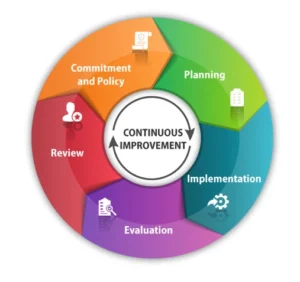
ISO 14001 emphasizes continuous improvement as a central concept. Organizations are guided to continuously improve environmental performance by identifying environmental aspects, setting environmental objectives, and taking appropriate measures to ensure performance enhancement.
The standard is built on the Plan-Do-Check-Act (PDCA) cycle—an iterative cycle and one of the basic elements of all modern management systems:
1. PLAN – Establish objectives and processes for improved environmental performance 2. DO – Implement the plans and measures defined in the planning step 3. CHECK – Monitor implementation, collect and evaluate results 4. ACT – Take appropriate actions based on findings, optimize weaknesses
After the fourth step completes, the cycle begins again—closing the circle of continuous improvement.
Structure of ISO 14001: Simply Explained
ISO 14001 follows the High-Level Structure (HLS)—a common framework for all modern management systems. This structure consists of 10 main sections with further subsections.
The 10 Sections of ISO 14001
Sections 1-3: Introduction
1. Scope
Defines the purpose of ISO 14001, what it can be used for, and who can use this standard.
2. Normative References
References to supplementary standards (none exist for DIN ISO 14001:2015).
3. Terms and Definitions
Brief explanation of key terms used throughout the standard.
Sections 4-10: Normative Requirements
4. Context of the Organization
Organizations must analyze their environment and interested parties. This section acts as a „capsule“ containing the PDCA cycle—aspects identified here influence all other normative requirements.
5. Leadership
Defines requirements for organization leadership. Leadership represents the center of the management system and PDCA cycle, carrying responsibility for steering, directing, and optimizing the EMS.
6. Planning (PLAN Phase)
Requirements for management system planning, including:
- Definition of objectives
- Risk and opportunity management
- Obligations and environmental aspects
- Legal compliance requirements
7. Support (DO Phase)
Addresses support processes including:
- Competencies and resources
- Communication
- Documented information (documents to create and retain)
8. Operation (DO Phase)
Focuses on operational planning and control:
- Operational controls for environmental aspects
- Emergency preparedness and response
9. Performance Evaluation (CHECK Phase)
Effectiveness verification through:
- Monitoring and measurement
- Compliance evaluation
- Internal audits
- Management review
10. Improvement (ACT Phase)
Ensures continuous system optimization:
- Nonconformity management
- Corrective actions
- Continual improvement of EMS effectiveness
Key ISO 14001 Requirements Explained
The standard establishes several core requirements organizations must fulfill for certification:
Developing an Environmental Policy
Organizations must develop an environmental policy documenting their commitment to environmental performance. This forms the foundation for the entire EMS and serves as a guide for all environmental behavior and activities. The policy should be:
- Approved by top management
- Understood and implemented by all employees
- Appropriate to the organization’s context
- Available to interested parties
- Committed to environmental protection and compliance
Defining and Implementing Environmental Objectives
Based on the environmental policy, organizations must establish environmental objectives and take appropriate measures to achieve them. Objectives should be:
- Measurable – Quantifiable results
- Realistic – Achievable with available resources
- Time-bound – Clear deadlines
- Relevant – Aligned with significant aspects
- Reviewed regularly – Updated as needed
Identifying Environmental Aspects
Organizations must identify their environmental aspects—elements of activities, products, or services that can have environmental impact. Categories include:
- Energy consumption
- Material use
- Waste management
- Water consumption and management
- Air emissions
- Biodiversity impacts
- Noise pollution
ISO 14001 promotes a preventive approach, identifying and addressing potential environmental impacts before they occur rather than merely reacting afterward—embodying risk-based thinking.
Implementing Legal Requirements
Organizations must identify, monitor, and ensure compliance with all relevant environmental laws and regulations applicable to their activities. Requirements vary by country, region, and industry.
Planning and Implementing an EMS
Organizations must develop and introduce a structured environmental management system covering:
- Understanding organizational context
- Leadership and commitment
- Risk assessment
- Environmental policy and objectives
- Action planning
- Resources and competencies
- Communication and documentation
- Implementation and operation
Resources and Competencies
Organizations must ensure necessary resources and competencies are available for EMS implementation, including:
- Employee training and awareness
- Financial resources
- Required infrastructure
- Technological support
- External expertise (consultants, specialists) when needed
Document and Record Control
Organizations must implement procedures for document control and recordkeeping to ensure relevant documents and records are properly managed—essential for organization, communication, tracking, and evidence.
Monitoring and Measurement
Organizations must implement processes to monitor and measure environmental performance, ensuring objectives are achieved through:
- Performance indicators (energy consumption, waste production, emission levels)
- Data collection (manual, automated sensors, software)
- Regular performance evaluation
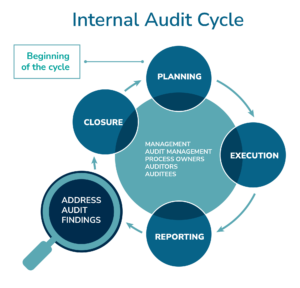
Internal Audits
Internal audits verify EMS conformity with ISO 14001 requirements. Results are documented, including:
- Identified deviations
- Improvement recommendations
- Positive aspects to highlight
This enables continuous EMS improvement.
Management Review
Top management must conduct regular management reviews to:
- Evaluate EMS performance
- Assess measure effectiveness
- Monitor progress toward objectives
- Ensure continued suitability and adequacy
Understanding Roles:
It’s crucial to understand that certification bodies and consultants serve different roles. Read our guide on ISO consulting vs certification: what’s the difference? to understand how the process works.
The ISO 14001 Certification Process
Once an environmental management system is successfully implemented, ISO 14001 certification can proceed. An independent certification body or environmental auditor conducts an external audit to verify the EMS meets ISO 14001 requirements.
Certification Timeline
Typical Process:
- Pre-Audit (Optional but Recommended) – 1-2 days
- Readiness check
- Identify gaps early
- €1,500-€4,000
- Stage 1 Audit – 1-2 days
- Documentation review
- Verify readiness for Stage 2
- Site assessment
- Stage 2 Audit – 2-10 days
- On-site implementation audit
- Full conformity assessment
- Employee interviews, process observations
- Follow-up Audit (if needed) – 1 day
- Address major nonconformities
- Verify corrections
After Certification
Upon passing the audit, the organization receives an ISO 14001:2015 certificate valid for three years. During this period:
- Annual surveillance audits ensure continued conformity
- After three years, a recertification audit renews the certificate
The ISO 14000 Family of Standards
ISO 14001 belongs to the ISO 14000 series—a group of environmental management standards and guidelines. Within this series exist various standard types with different scopes and orientations.
Three Main Categories
1. Organization-Oriented Standards
ISO 14001 – The most well-known standard, establishing EMS requirements to help organizations identify, monitor, and reduce environmental impacts. Focuses on how organizations manage environmental impacts regarding processes, products, and services.
2. Product-Oriented Standards
ISO 14020-14025 – Environmental labels and declarations providing information about product environmental impacts throughout their lifecycle. ISO 14025 establishes requirements for Environmental Product Declarations (EPDs).
3. Mixed Forms
Some standards cover both organizational and product aspects:
ISO 14031 – Guidelines for evaluating organizational environmental performance, including both organizational and product-related information.
Selecting a DAkkS-Accredited Certification Body
Choosing the right certification body is crucial for a successful certification experience and certificate credibility.
Understanding DAkkS Accreditation
Deutsche Akkreditierungsstelle (DAkkS) serves as Germany’s sole national accreditation body, operating under:
- Akkreditierungsstellengesetz (German Accreditation Act)
- EU Regulation 765/2008
- ISO/IEC 17011
Why DAkkS Accreditation is Essential:
- ✅ Legal requirement for official recognition in Germany
- ✅ Required for public sector contracts
- ✅ Enhanced credibility with authorities
- ✅ Mutual recognition across EU member states
- ✅ Assurance of certification body competence
Verification: Visit www.dakks.de to verify current accreditation status before engaging any certification body.
While we help you select the right certification body, Sternberg Consulting guides you through implementation and audit preparation. Learn more about our services.
Why Choose Sternberg Consulting?
Our Approach
Practical Systems That Work
We build environmental management systems aligned with your actual operations—not generic templates that sit on shelves.
Multi-Industry Expertise
Experience across manufacturing, medical devices, construction, IT, and service sectors. We understand your industry’s unique environmental challenges.
Integrated Management Systems
Already have ISO 9001, ISO 13485, or ISO 45001? We specialize in integration, reducing documentation burden and audit costs by 20-40%.
🇩🇪 German Market Excellence
Based in Dresden, we understand DAkkS requirements, German environmental regulations (KrWG, BImSchG, WHG), and local business culture.
Fast Implementation
Our streamlined methodology achieves certification readiness in 6-18 months depending on your organization’s size and complexity.
Certified Expertise
Certified internal auditor and external QMR with proven track record across diverse industries.
Our Services Include
- ✅ Gap analysis and readiness assessment
- ✅ Environmental aspects identification workshops
- ✅ Legal compliance register (Rechtskataster) development
- ✅ Complete EMS documentation
- ✅ Employee training and awareness programs
- ✅ Internal audit preparation and execution
- ✅ Certification body selection guidance
- ✅ Audit support and preparation
- ✅ External QMR/Umweltmanagementbeauftragter services
- ✅ Post-certification ongoing support
Already working with us on ISO 9001 or other standards? Adding ISO 14001 through integration is efficient and cost-effective. Contact us to discuss your options.
Frequently Asked Questions
Q: Is ISO 14001 certification mandatory?
A: No, it’s voluntary. However, it may be required by customers, supply chains, or for public sector contracts.
Q: How long does certification take?a
A: Typically 6-18 months depending on organization size, complexity, and current EMS maturity.
Q: What is DAkkS accreditation?
A: Germany’s sole national accreditation body ensuring certification body competence. Essential for official German recognition.
Q: Can small businesses get certified?
A: Yes! ISO 14001 scales to any organization size. Small businesses often certify faster due to lower complexity.
Q: What’s the difference between ISO 14001 and EMAS?
A: EMAS is EU-specific, more stringent, and includes ISO 14001 plus additional requirements like public environmental statements. ISO 14001 offers global recognition.
Q: Can we integrate ISO 14001 with ISO 9001?
A: Yes! The common High-Level Structure facilitates integration with ISO 9001, ISO 45001, and other standards, saving 20-40% versus separate systems.
Q: Does Sternberg Consulting provide certification?
A: No. To maintain objectivity, consultants implement and certification bodies audit. This independence ensures credible certification. We prepare you for success with a separate DAkkS-accredited body.
Q: What are typical costs?
A: Small organizations: €13,000-€26,000 Year 1. Medium: €31,000-€65,000. Large: €65,000-€130,000+. ROI typically within 18 months through operational savings.

