

Einleitung: Zwei Wege zur ISO 9001 Zertifizierung
Wer eine ISO 9001 Zertifizierung anstrebt, steht vor einer grundlegenden Entscheidung: Soll die Implementierung eigenständig oder mit professioneller Unterstützung erfolgen?Weg 1: ISO 9001 Implementierung mit Unterstützung eines Beraters
Ein erfahrener ISO-Berater übernimmt das Projektmanagement, erstellt die Dokumentation, führt eine Gap-Analyse durch, bereitet das Team auf Audits vor und begleitet das Unternehmen bis zur erfolgreichen Zertifizierung. Dieser Ansatz spart Zeit, minimiert Risiken und ermöglicht es, Branchenerfahrung zu nutzen. Sternberg Consulting bietet diese Unterstützung speziell für kleine und mittlere Unternehmen in der DACH-Region – von der Erstanalyse bis zum Zertifikat.Weg 2: Eigenständige ISO 9001 Implementierung für KMU
Mit dem richtigen Wissen, ausreichend Zeit und einem strukturierten Ansatz können Sie auch eigenständig ein Qualitätsmanagementsystem (QMS) aufbauen. Dieser Leitfaden richtet sich an alle, die diesen Weg gehen möchten. Er beschreibt alle erforderlichen Schritte, erklärt die Anforderungen der Norm und weist auf häufige Fallstricke hin.Eine wichtige Hürde für die eigenständige Implementierung
ISO 9001 erfordert die Durchführung interner Audits. Sie müssen die Kompetenz interner Auditoren nachweisen, insbesondere Kenntnisse der Norm und Audittechniken. Ohne einen externen Berater, der diese Qualifikation bereitstellen kann, ist in der Regel ein QMS-Kurs oder eine Schulung zum internen Auditor erforderlich. Berücksichtigen Sie dies von Anfang an bei der Planung Ihres Weges zur ISO 9001 Zertifizierung. Wichtiger Hinweis: Unabhängig davon, welcher Weg gewählt wird, ist der Erwerb und das gründliche Studium der ISO 9001:2015 Norm unerlässlich. Die Norm ist beim Beuth Verlag oder direkt bei der ISO erhältlich und dient als verbindliche Grundlage für alle Zertifizierungsaudits.Abkürzungsverzeichnis und Definitionen
| Abkürzung | Bedeutung |
|---|---|
| 8D | Eight Disciplines. Eine Problemlösungsmethodik zur Ermittlung der Grundursache eines Problems, zur Entwicklung einer kurzfristigen Lösung und zur Implementierung einer langfristigen Lösung. |
| BAFA | Bundesamt für Wirtschaft und Ausfuhrkontrolle. |
| DACH | D (Deutschland), A (Österreich), CH (Schweiz). Ein Akronym für die drei großen deutschsprachigen Länder in Europa. |
| DAkkS | Deutsche Akkreditierungsstelle. Die nationale Akkreditierungsstelle für die Bundesrepublik Deutschland. |
| DIY | Do It Yourself (Eigenständig umsetzen). |
| ESF | Europäischer Sozialfonds. |
| FIFO | First-In, First-Out. Ein Prinzip der Bestandsrotation, das sicherstellt, dass der älteste Bestand (zuerst eingetroffenes Material) vor neuerem Bestand verwendet oder versandt wird, um Verfall oder Veralterung zu verhindern. |
| FMEA | Fehlermöglichkeits- und Einflussanalyse. Eine systematische Technik zur Identifizierung vorhersehbarer Fehlermodi in einem Produkt oder Prozess und zur Bewertung des mit diesen Fehlermodi verbundenen Risikos. |
| HLS | High Level Structure (Harmonisierte Struktur). |
| IMS | Integriertes Managementsystem. |
| ISO | Internationale Organisation für Normung. |
| KPI | Key Performance Indicator (Leistungskennzahl). |
| OEM | Original Equipment Manufacturer (Erstausrüster). |
| OFI | Opportunity for Improvement (Verbesserungspotenzial). |
| PDCA | Plan-Do-Check-Act (Planen-Durchführen-Prüfen-Handeln). |
| QMB | Qualitätsmanagementbeauftragter. |
| QMS | Qualitätsmanagementsystem. |
| SMART | Spezifisch, Messbar, Erreichbar, Relevant, Terminiert. |
| KMU | Kleine und mittlere Unternehmen. |
| TÜV | Technischer Überwachungsverein. Eine Gruppe von Beratungs- und Prüforganisationen in der DACH-Region, die auch als wichtige Zertifizierungsstellen für ISO-Normen fungieren. |
Teil 1: Warum ISO 9001 für KMU in der DACH-Region relevant ist
Wettbewerbsvorteile im deutschsprachigen Markt
Die DACH-Region zeichnet sich durch eine ausgeprägte Qualitätskultur aus. Deutsche, österreichische und Schweizer Unternehmen genießen weltweit einen hervorragenden Ruf – und dieser Ruf basiert auf systematischem Qualitätsmanagement. Für kleine und mittlere Unternehmen bedeutet die ISO 9001 Zertifizierung mehr als nur ein Zertifikat an der Wand. Sie signalisiert Kunden und Geschäftspartnern, dass die Organisation strukturierte interne Prozesse hat, Kundenanforderungen systematisch erfasst und kontinuierliche Verbesserung praktiziert. In einem Markt, in dem Kundenorientierung, Vertrauen und Zuverlässigkeit entscheidende Kaufkriterien sind, kann dies den Unterschied zwischen dem Gewinn und dem Verlust eines Auftrags ausmachen. Besonders im Maschinenbau, der eine zentrale Rolle in der DACH-Region spielt, ist ISO 9001 praktisch zum Industriestandard geworden. Ingenieurbüros, Zulieferer und Systemintegratoren werden regelmäßig nach ihrer Zertifizierung gefragt – oft schon vor jeder Diskussion über die Projekte.Ausschreibungen und öffentliche Aufträge
Öffentliche Auftraggeber in Deutschland, Österreich und der Schweiz verlangen in Ausschreibungen häufig den Nachweis eines zertifizierten Qualitätsmanagementsystems. Dies gilt insbesondere für technische Dienstleistungen, Maschinen- und Anlagenbau sowie Lieferungen für kritische Infrastruktur. Ohne ISO 9001 Zertifizierung bleiben viele dieser Aufträge unerreichbar. Die Zertifizierung öffnet nicht nur Türen zu neuen Kunden, sondern erweitert auch den adressierbaren Markt erheblich.Anforderungen der Lieferkette
Große OEMs und Systemhäuser im deutschsprachigen Raum verlangen von ihren Lieferanten zunehmend ISO 9001. Die Automobilindustrie, der Maschinenbau und die Medizintechnik sind hier besonders streng. Die Logik dahinter ist einfach: Ein zertifizierter Lieferant bietet größere Prozesssicherheit. Reklamationsquoten sind typischerweise niedriger, die Rückverfolgbarkeit ist gewährleistet, und im Problemfall gibt es definierte Eskalationswege. Für Einkaufsabteilungen reduziert dies das Risiko erheblich. Unternehmen, die Lieferant sind oder werden wollen, sollten ISO 9001 nicht als optionales Extra betrachten, sondern als Grundvoraussetzung für Geschäftsbeziehungen auf Augenhöhe.BAFA-Förderung: Finanzielle Unterstützung für Beratung
Das Bundesamt für Wirtschaft und Ausfuhrkontrolle (BAFA) bietet mit dem Programm “Förderung unternehmerischen Know-hows für KMU” eine attraktive Möglichkeit, die Kosten professioneller Beratung zu reduzieren.Wer wird gefördert?
Kleine und mittlere Unternehmen mit Sitz in Deutschland, die
Wie hoch ist die Förderung?
Die Fördersätze unterscheiden sich nach Region:- Neue Bundesländer (ohne Berlin und Leipzig), Region Lüneburg, Region Trier: 80% der Beratungskosten, maximal 2.800 Euro
- Alte Bundesländer (einschließlich Berlin und Leipzig): 50% der Beratungskosten, maximal 1.750 Euro
Wie viele Beratungen sind möglich?
Innerhalb der Gültigkeitsdauer der Förderrichtlinie (bis 31. Dezember 2026) können maximal fünf Beratungen gefördert werden, jedoch nicht mehr als zwei pro Jahr.Wie läuft das Verfahren?
Der Antrag wird online über die BAFA-Plattform gestellt. Nach Prüfung erhält das Unternehmen ein Informationsschreiben, das den Beginn der Beratung ermöglicht. Wichtig: Eine rückwirkende Förderung ist ausgeschlossen. Sie können den Beratungsvertrag erst nach Erhalt des Schreibens abschließen. Nach Abschluss der Beratung muss innerhalb von sechs Monaten der Verwendungsnachweis eingereicht werden. Dieser umfasst den Beratungsbericht und verschiedene Formulare.Welche Berater sind zugelassen?
Die Beratung muss von bei der BAFA registrierten Beratern durchgeführt werden. Sternberg Consulting ist als BAFA-zugelassener Berater registriert und bietet Unterstützung sowohl bei der Antragstellung als auch bei der eigentlichen QMS-Implementierung.Teil 2: ISO 9001:2015 verstehen
Der Prozessansatz erklärt
ISO 9001:2015 basiert grundlegend auf dem Prozessansatz und den Qualitätsmanagement-Grundsätzen. Das bedeutet, dass ein Unternehmen nicht als Sammlung einzelner Abteilungen betrachtet wird,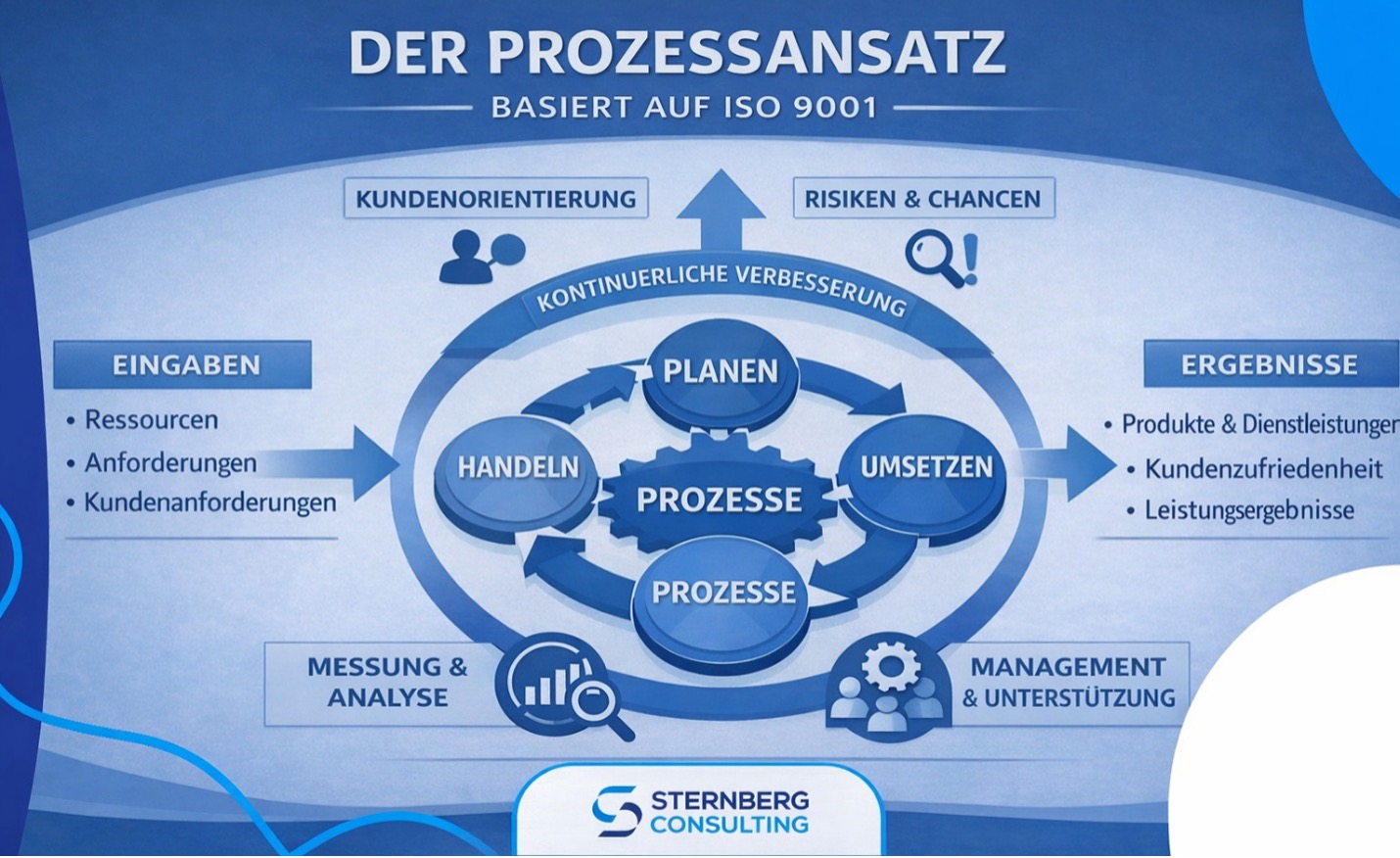
- Prozesse identifizieren: Welche Prozesse gibt es im Unternehmen? Welche sind wertschöpfend, welche unterstützend?
- Wechselwirkungen verstehen: Welche Schnittstellen bestehen zwischen den Prozessen? Wo sind die Übergabepunkte?
- Verantwortlichkeiten definieren: Wer ist für welchen Prozess verantwortlich? Wer kontrolliert die Schnittstellen?
- Kennzahlen definieren: Wie wird die Leistung jedes Prozesses gemessen? Was sind die kritischen Erfolgsfaktoren?
Risikobasiertes Denken für KMU
Die Revision 2015 von ISO 9001 hat das risikobasierte Denken als durchgängiges Prinzip verankert. Die Norm verlangt jedoch kein formales Risikomanagement nach ISO 31000. Für KMU ist ein pragmatischer Ansatz ausreichend. Risikobasiertes Denken bedeutet, bei jeder Entscheidung zu fragen: Was kann schiefgehen? Welche Chancen könnten verpasst werden? Wie wahrscheinlich ist es? Welche Auswirkungen hätte es? Sie müssen Risiken und Chancen für jeden Prozess innerhalb des Qualitätsmanagementsystems identifizieren – nicht nur auf der übergeordneten Unternehmensebene. Die Standardprozesse, die praktisch in jedem Unternehmen existieren, bieten einen guten Ausgangspunkt.Standardprozesse und zugehörige Risiken und Chancen
| Prozess | Risiken | Chancen |
|---|---|---|
| Vertrieb und Auftragsannahme | Unklare Kundenanforderungen, unrealistische Terminzusagen, Kreditrisiken | Cross-Selling, Kundenbindung durch Beratungskompetenz |
| Entwicklung und Design | Fehlende Spezifikationen, Änderungsschleifen, Normänderungen | Innovation, Standardisierung von Baugruppen |
| Beschaffung | Lieferantenausfall, Lieferverzögerungen, Qualitätsprobleme bei Zukaufteilen | Alternative Lieferanten, Rahmenverträge, Materialkostenreduzierung |
| Produktion und Montage | Maschinenausfall, Kapazitätsengpässe, Qualitätsschwankungen, Ausschuss | Prozessoptimierung, Automatisierung, Rüstzeitreduzierung |
| Prüfung und Qualitätskontrolle | Unentdeckte Fehler, Messgeräteausfall, Fehlentscheidungen | Präventive Fehlererkennung, Prozessfähigkeitsverbesserung |
| Lieferung und Versand | Transportschäden, Lieferverzögerungen, Falschlieferungen | Optimierte Logistik, Verpackungsstandards |
| Personalmanagement | Know-how-Verlust durch Fluktuation, Fachkräftemangel, fehlende Kompetenzen | Mitarbeiterentwicklung, Wissensmanagement |
| Kundenservice und After-Sales | Unzufriedene Kunden, Reklamationskosten, Reputationsschaden | Kundenbindung, Servicegeschäft, Feedback zur Produktverbesserung |
Führung und Verpflichtung der obersten Leitung
Abschnitt 5 der ISO 9001 stellt klare Anforderungen an die oberste Leitung. Dies ist keine Formalität –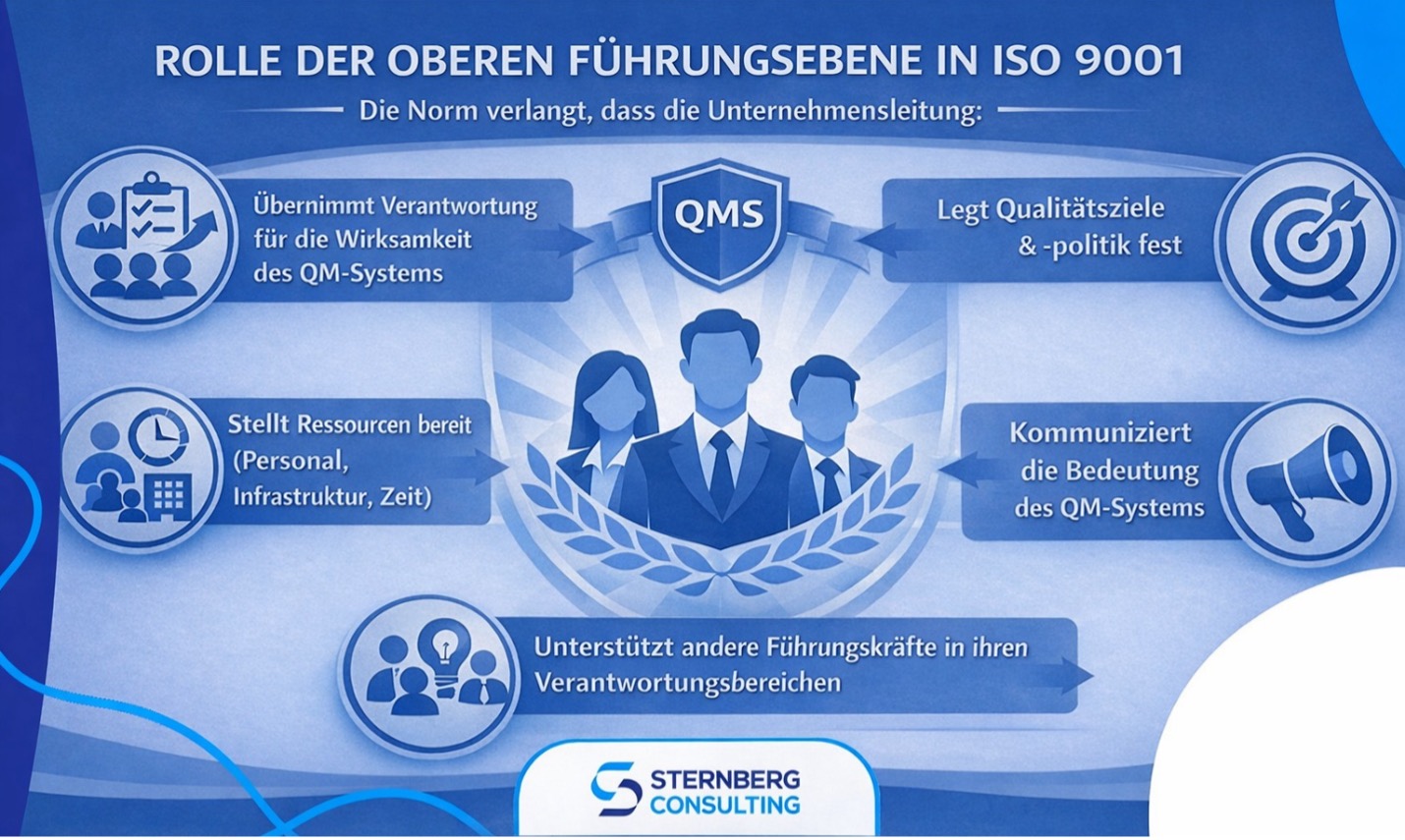
- Rechenschaftspflicht für die Wirksamkeit des Qualitätsmanagementsystems übernimmt
- Qualitätspolitik und Qualitätsziele festlegt, die zur strategischen Ausrichtung passen
- Ressourcen bereitstellt (Personal, Infrastruktur, Zeit)
- Die Bedeutung eines wirksamen QMS und der Erfüllung von Anforderungen kommuniziert
- Andere Führungskräfte in ihren Verantwortungsbereichen unterstützt
Kontext der Organisation
Abschnitt 4 der Norm verlangt, dass ein Unternehmen seinen Kontext versteht – sowohl intern als auch extern. Dies bildet die Grundlage für alle weiteren QMS-Entscheidungen. Externe Themen können sein:- Gesetzliche und regulatorische Anforderungen (Maschinenrichtlinie, Produkthaftung)
- Technologische Entwicklungen (Industrie 4.0, Digitalisierung)
- Wettbewerbssituation
- Wirtschaftliche Rahmenbedingungen
- Kundenerwartungen und Markttrends
- Unternehmenswerte und -kultur
- Organisationsstruktur
- Vorhandenes Know-how und Kompetenzen
- Technische Ausstattung und Infrastruktur
- Finanzielle Ressourcen
Teil 3: Vorbereitung auf die Implementierung
Gap-Analyse: Der Ist-Zustand
Bevor Sie mit dem Aufbau des QMS beginnen, machen Sie eine ehrliche Bestandsaufnahme. Eine Gap-Analyse kann zeigen, welche Anforderungen der Norm bereits erfüllt sind und wo Verbesserungsbedarf besteht.Systematisches Vorgehen:
- Normanforderungen auflisten: Betrachten Sie jede Anforderung der ISO 9001:2015 einzeln (Abschnitt 4 bis 10).
- Ist-Zustand bewerten für jede Anforderung:
- Vollständig erfüllt (entsprechende Prozesse und Dokumentation vorhanden)
- Teilweise erfüllt (Ansätze vorhanden, aber Lücken erkennbar)
- Nicht erfüllt (keine entsprechenden Regelungen)
- Lücken dokumentieren: Detailliert festhalten, wo der aktuelle Status vom geforderten Standard abweicht.
- Maßnahmen ableiten: Für jede Lücke werden notwendige Maßnahmen definiert.
Ressourcenbedarf realistisch planen
Die Implementierung eines QMS erfordert Ressourcen – und mehr als viele kleine Unternehmen zunächst erwarten. Realistische Planung verhindert spätere Frustration und Projektverzögerungen.Zeitbedarf:
- Projektmanagement (interner QM-Beauftragter): 20–40% der Arbeitszeit über die Projektdauer
- Geschäftsleitung: 5–10% der Arbeitszeit für Reviews, Entscheidungen, Kommunikation
- Abteilungsleiter und Prozessverantwortliche: 5–15% für Prozessdefinition, Schulung, Mitarbeit
- Alle Mitarbeiter: Zeit für Schulung und Einarbeitung in neue Prozesse
Typische Projektdauer:
- Kleine Unternehmen (< 20 Mitarbeiter) mit einfacher Struktur: 3–6 Monate
- Mittlere Unternehmen (20–100 Mitarbeiter): 6–12 Monate
- Komplexere Strukturen oder zusätzliche Anforderungen: 12–18 Monate
Weitere Ressourcen:
- Budget für Beratung (falls gewünscht), Schulungen, Dokumentationssysteme
- IT-Infrastruktur für Dokumentenlenkung
- Mögliche externe Unterstützung für interne Audits
Implementierungsweg wählen
Es gibt verschiedene Wege zur Zertifizierung. Die Wahl hängt von verfügbaren Ressourcen, Dringlichkeit und gewünschter Lernkurve ab.Vollständig eigenständige Implementierung:
- Geeignet für Unternehmen mit QM-erfahrenen Mitarbeitern
- Höchster interner Lerneffekt
- Längste Projektdauer und höchstes Fehlerrisiko
- Niedrigste externe Kosten
Mit Beraterunterstützung:
- Strukturiertes Vorgehen durch erfahrenen Experten
- Schnellere Implementierung mit reduziertem Risiko
- Know-how-Transfer an interne Mitarbeiter
- Höhere externe Kosten, aber oft niedrigere Gesamtkosten durch Effizienz
Hybridansatz:
- Berater für kritische Phasen (Gap-Analyse, Auditvorbereitung)
- Eigenständige Umsetzung dokumentierter Maßnahmen
- Guter Kompromiss zwischen Kosten und Sicherheit
Realistische Zeitplanung
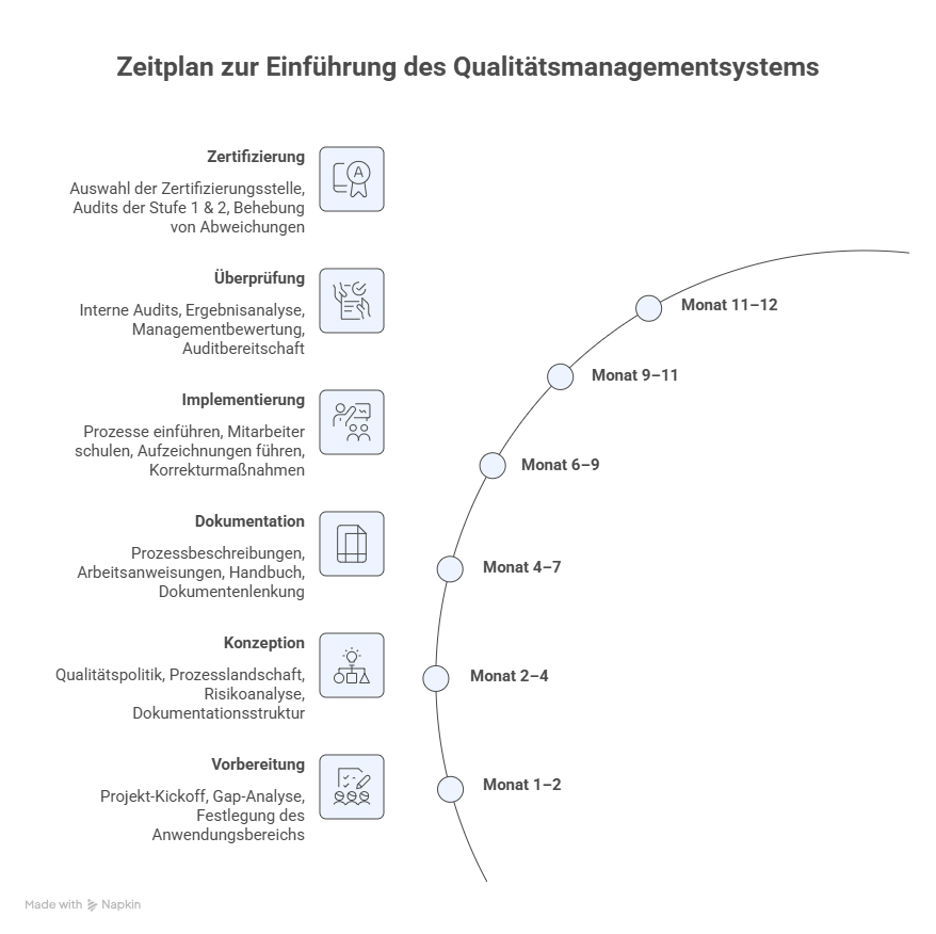
Phase 1 – Vorbereitung (Monat 1–2):
- Projekt-Kickoff und Ressourcenplanung
- Gap-Analyse durchführen
- Kontext und interessierte Parteien ermitteln
- Anwendungsbereich des QMS festlegen
Phase 2 – Konzeption (Monat 2–4):
- Qualitätspolitik und Qualitätsziele definieren
- Prozesslandkarte erstellen
- Risikoanalyse durchführen
- Dokumentationsstruktur festlegen
Phase 3 – Dokumentation (Monat 4–7):
- Prozessbeschreibungen erstellen
- Arbeitsanweisungen und Formulare entwickeln
- QM-Handbuch erstellen (falls gewünscht)
- Dokumentenlenkung implementieren
Phase 4 – Umsetzung (Monat 6–9):
- Prozesse im Tagesgeschäft einführen
- Mitarbeiter schulen
- Aufzeichnungen führen
- Korrekturmaßnahmen bei Abweichungen
Phase 5 – Überprüfung (Monat 9–11):
- Interne Audits durchführen
- Feststellungen analysieren und Maßnahmen umsetzen
- Managementbewertung durchführen
- Auditreife herstellen
Phase 6 – Zertifizierung (Monat 11–12):
- Zertifizierungsstelle auswählen
- Stufe-1-Audit (Dokumentenprüfung)
- Stufe-2-Audit (Vor-Ort-Audit)
- Nichtkonformitäten und OFIs behandeln
Teil 4: Aufbau des Qualitätsmanagementsystems
Qualitätspolitik und Qualitätsziele
ISO 9001:2015 Anforderungen an die Qualitätspolitik (Abschnitt 5.2):
Die oberste Leitung muss eine Qualitätspolitik festlegen, umsetzen und aufrechterhalten, die:- für den Zweck und Kontext der Organisation angemessen ist und deren strategische Ausrichtung unterstützt
- einen Rahmen für die Festlegung von Qualitätszielen bietet
- eine Verpflichtung zur Erfüllung zutreffender Anforderungen enthält
- eine Verpflichtung zur fortlaufenden Verbesserung des QMS enthält
ISO 9001:2015 Anforderungen an Qualitätsziele (Abschnitt 6.2):
Die Organisation muss Qualitätsziele für relevante Funktionen, Ebenen und Prozesse festlegen. Qualitätsziele müssen:- mit der Qualitätspolitik vereinbar sein
- messbar sein
- zutreffende Anforderungen berücksichtigen
- für die Konformität von Produkten und Dienstleistungen und für die Erhöhung der Kundenzufriedenheit relevant sein
- überwacht werden
- kommuniziert werden
- soweit erforderlich aktualisiert werden
- Was getan wird
- Welche Ressourcen erforderlich sind
- Wer verantwortlich ist
- Wann es abgeschlossen sein wird
- Wie die Ergebnisse bewertet werden
Praktische Umsetzung der Qualitätspolitik:
Die Qualitätspolitik ist die übergeordnete Absichtserklärung der obersten Leitung bezüglich Qualität. Sie muss für den Zweck und Kontext der Organisation angemessen sein, einen Rahmen für Qualitätsziele bieten, eine Verpflichtung zur Erfüllung von Anforderungen und zur kontinuierlichen Verbesserung enthalten.Typische Fehler bei der Qualitätspolitik:
- Zu allgemein und austauschbar (“Wir liefern Qualität”)
- Zu lang und schwer zu verstehen und zu merken
- Kein Bezug zum tatsächlichen Geschäftsbetrieb
- Nicht von der Geschäftsleitung unterstützt
- Reklamationsquote im laufenden Jahr unter 1% des Umsatzes
- Liefertermintreue im laufenden Jahr über 95%
- Erstmusterfreigabe im laufenden Jahr bei 90% der Teile ohne Nacharbeit
- Kundenzufriedenheitsindex im laufenden Jahr über 8 von 10 Punkten
Prozesslandkarte und Prozessdokumentation
Die Prozesslandkarte visualisiert alle relevanten Prozesse des Unternehmens und ihre Beziehungen.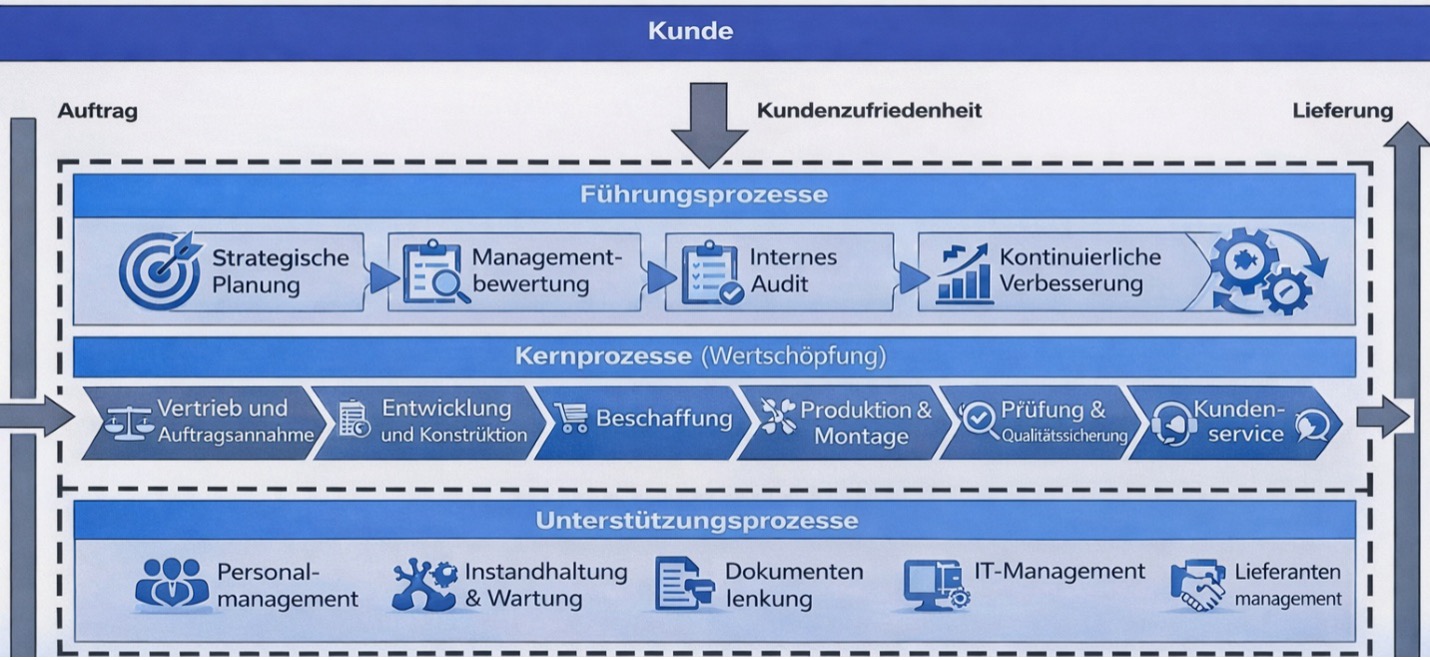
Typische Prozessstruktur:
Managementprozesse:
- Strategische Planung
- Managementbewertung
- Internes Audit
- Kontinuierliche Verbesserung
Kernprozesse (Wertschöpfung):
- Vertrieb und Auftragsannahme
- Entwicklung und Design
- Beschaffung
- Produktion und Montage
- Prüfung und Qualitätskontrolle
- Lieferung und Inbetriebnahme
- Kundenservice
Unterstützungsprozesse:
- Personalmanagement (inkl. Schulung und Kompetenzmanagement)
- Infrastruktur und Instandhaltung
- Dokumentenlenkung
- Prüfmittelverwaltung
- IT-Management
- Lieferantenmanagement
- Zweck und Anwendungsbereich
- Prozessverantwortlicher und beteiligte Rollen
- Eingaben und Ausgaben
- Wesentliche Aktivitäten und Arbeitsabläufe
- Schnittstellen zu anderen Prozessen
- Kennzahlen zur Überwachung
- Risiken und Chancen
- Relevante Dokumente und Aufzeichnungen
Rollen und Verantwortlichkeiten
Klare Verantwortlichkeiten sind grundlegend für ein funktionierendes QMS. Die Norm verlangt, dass Verantwortlichkeiten und Befugnisse in der Organisation zugewiesen und kommuniziert werden.Wichtige Rollen im QMS:
Oberste Leitung (Geschäftsführung):
- Gesamtverantwortung für das QMS
- Festlegung von Qualitätspolitik und Qualitätszielen
- Bereitstellung von Ressourcen
- Durchführung der Managementbewertung
Qualitätsmanagementbeauftragter (QMB):
Hinweis: ISO 9001:2015 fordert nicht mehr explizit einen QMB. Die Aufgaben müssen jedoch weiterhin wahrgenommen werden:- Sicherstellung der Normkonformität
- Berichterstattung an die oberste Leitung
- Koordination des QMS
- Förderung des Qualitätsbewusstseins
Prozessverantwortliche:
- Verantwortung für ihren jeweiligen Prozess
- Sicherstellung der Prozessleistung
- Kontinuierliche Verbesserung des Prozesses
- Steuerung der Schnittstellen
Interne Auditoren:
- Durchführung interner Audits
- Unabhängigkeit von auditierten Bereichen
- Berichterstattung der Ergebnisse
Hinweis zu Organigrammen:
Obwohl ISO 9001:2015 nicht explizit ein Organigramm fordert, ist es die gebräuchlichste und effektivste Methode, die Organisationsstruktur zu dokumentieren und die Anforderungen von Abschnitt 5.3 zu erfüllen. Auditoren erwarten typischerweise eines zu sehen. Das Organigramm sollte Berichtslinien, Schlüsselpositionen, Abteilungen zeigen und QMS-spezifische Rollen (QMB, Prozessverantwortliche, interne Auditoren) klar kennzeichnen. Konzentrieren Sie sich auf QMS-relevante Positionen statt jeden Mitarbeiter aufzulisten und stellen Sie sicher, dass es als gelenktes Dokument mit ordnungsgemäßer Versionierung gepflegt wird.Dokumentenstruktur und -lenkung
ISO 9001:2015 spricht von “dokumentierter Information”. Dies umfasst sowohl Dokumente (Vorgaben wie Prozessbeschreibungen, Arbeitsanweisungen) als auch Aufzeichnungen (Nachweise wie Prüfprotokolle, Schulungsnachweise).Typische Dokumentenhierarchie:
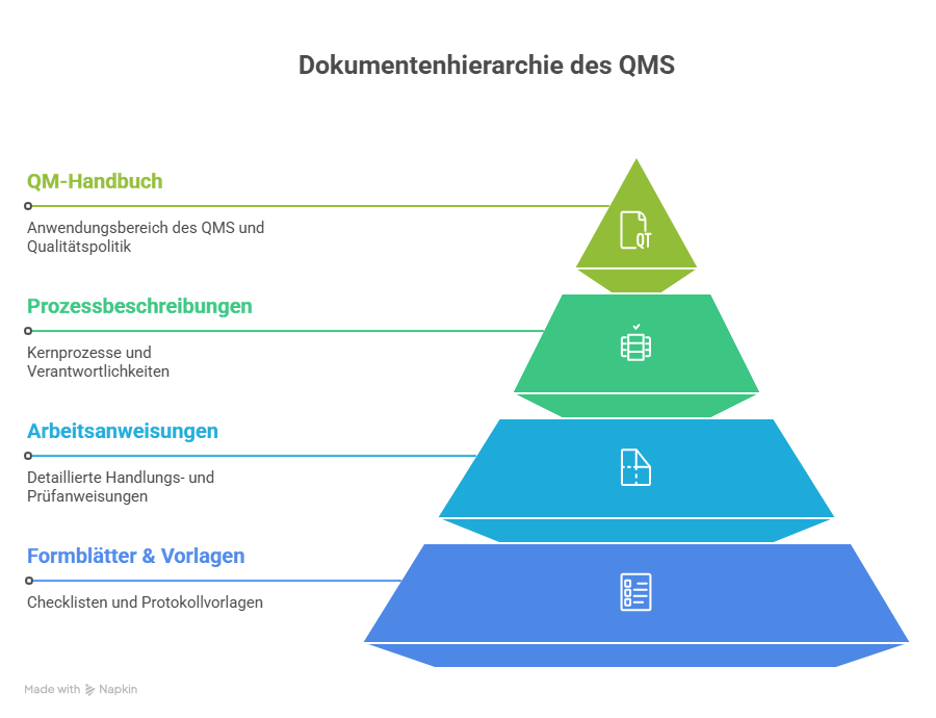
- Beschreibung des QMS-Anwendungsbereichs
- Qualitätspolitik
- Prozesslandkarte
- Verweise auf detailliertere Dokumente
Ebene 2 – Prozessbeschreibungen:
- Darstellung der Kernprozesse
- Verantwortlichkeiten und Arbeitsabläufe
- Schnittstellen
Ebene 3 – Arbeitsanweisungen:
- Detaillierte Handlungsanweisungen
- Prüfanweisungen
- Spezifikationen
Ebene 4 – Formulare und Vorlagen:
- Checklisten
- Protokollvorlagen
- Formulare für Aufzeichnungen
Dokumentenlenkung
Dokumentenlenkung muss sicherstellen, dass:- Dokumente vor der Freigabe auf Angemessenheit geprüft werden
- Dokumente bei Bedarf aktualisiert und erneut freigegeben werden
- Der aktuelle Revisionsstatus erkennbar ist
- Gültige Dokumente am Einsatzort verfügbar sind
- Veraltete Dokumente nicht unbeabsichtigt verwendet werden
- Externe Dokumente (Normen, Kundenspezifikationen) identifiziert und gelenkt werden
Teil 5: Erstellung der Kerndokumentation
QM-Handbuch: Erforderlich oder nicht?
ISO 9001:2015 fordert nicht mehr explizit ein QM-Handbuch. Dennoch ist die Erstellung eines QM-Handbuchs sehr empfehlenswert, besonders für kleine Unternehmen, die das QMS eigenständig aufbauen.Empfehlung: Strukturieren Sie das Handbuch entsprechend der ISO 9001 Normstruktur
Nach meiner Erfahrung ist ein bewährter Ansatz, das Handbuch entlang der Kapitelstruktur der ISO 9001 (Abschnitt 4 bis 10) zu strukturieren. Für jeden Normabschnitt beschreiben Sie, wie das Unternehmen die jeweilige Anforderung erfüllt – mit Verweisen auf die entsprechenden Prozessbeschreibungen, Arbeitsanweisungen und Formulare. Dieser Ansatz bietet mehrere Vorteile:- Vollständigkeitsprüfung: Das Durcharbeiten der Norm Kapitel für Kapitel stellt sicher, dass keine Anforderungen übersehen werden.
- Auditvorbereitung: Der Auditor kann aus dem Handbuch sofort erkennen, wie Sie jede Anforderung umsetzen. Wenn die Beschreibung klar und verständlich ist, spart dies viele Rückfragen im Audit – der Auditor entnimmt die Informationen direkt dem Handbuch.
- Einarbeitung neuer Mitarbeiter: Das Handbuch dient als Leitfaden zum Verständnis des gesamten QMS.
- Referenz im Tagesgeschäft: Bei Unsicherheiten können Sie schnell nachschlagen, welche Regeln und Anforderungen gelten.
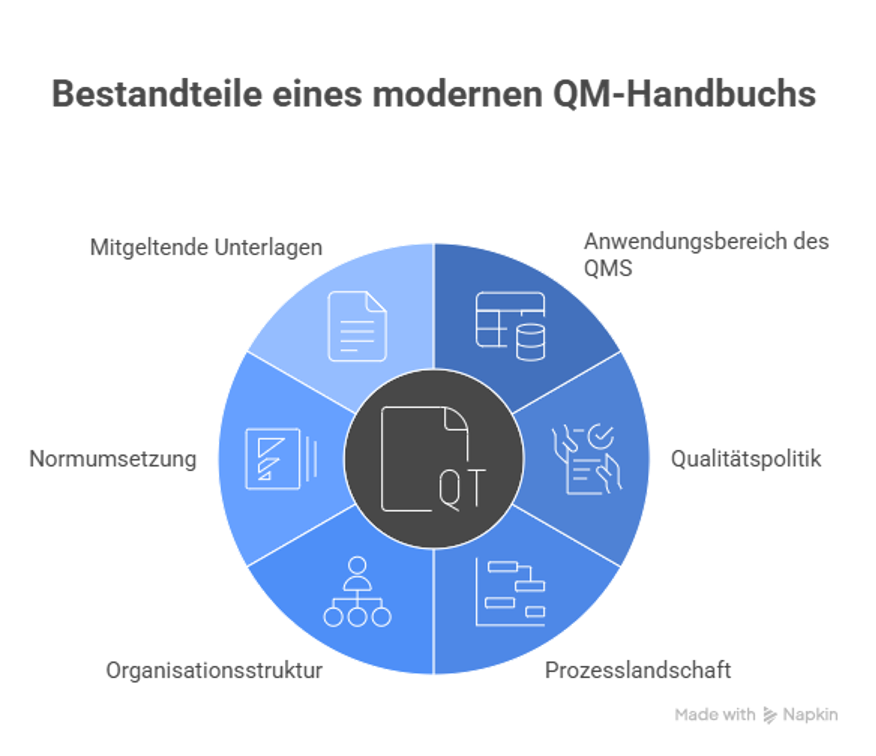
- Anwendungsbereich des QMS
- Qualitätspolitik
- Prozesslandkarte
- Organisationsstruktur
- Beschreibung der Normumsetzung nach Kapiteln
- Verweise auf detaillierte Dokumente
Dokumentierte Verfahren gemäß ISO 9001:2015
Die Norm schreibt dokumentierte Information nur für bestimmte Bereiche explizit vor. Diese “Pflichtdokumente” sind das Minimum:Erforderliche dokumentierte Information (Vorgaben):
- Anwendungsbereich des QMS
- Qualitätspolitik
- Qualitätsziele
- Kriterien für die Bewertung und Auswahl von Lieferanten
- Soweit erforderlich: Prozessbeschreibungen, Arbeitsanweisungen
Erforderliche Aufzeichnungen (Nachweise):
- Nachweis der Mitarbeiterkompetenz
- Ergebnisse der Managementbewertungen
- Ergebnisse interner Audits
- Ergebnisse von Korrekturmaßnahmen
- Überwachungs- und Messergebnisse
- Freigabe von Produkten und Dienstleistungen
- Rückverfolgbarkeit (soweit erforderlich)
- Nachweis für Kundeneigentum
- Lenkung nichtkonformer Ergebnisse
- Lieferantenbewertung und -freigabe
- Ergebnisse der Designverifizierung und -validierung (falls Entwicklung im Anwendungsbereich des QMS)
Arbeitsanweisungen und Formulare
Arbeitsanweisungen legen genau fest, wie Aufgaben ausgeführt werden müssen. Sie sind besonders wichtig für komplexe Prozesse, die Einarbeitung neuer Mitarbeiter, die Aufrechterhaltung hoher Qualitätsstandards und die Einhaltung von Sicherheitsvorschriften.Merkmale guter Arbeitsanweisungen:
- Klar und verständlich formuliert
- Auf die Zielgruppe zugeschnitten
- Praxisnah und aktuell
- Mit Bildern oder Diagrammen, wo hilfreich
- Am Arbeitsplatz verfügbar
Lenkung von Aufzeichnungen
Aufzeichnungen sind Nachweise dafür, dass Prozesse wie geplant durchgeführt wurden. Diese Aufzeichnungen müssen lesbar, identifizierbar, auffindbar und geschützt sein.Stellen Sie sicher, dass Sie festlegen:
- Wo werden Aufzeichnungen abgelegt?
- Wer ist für die Ablage verantwortlich?
- Wie lange werden Aufzeichnungen aufbewahrt?
- Wie werden Aufzeichnungen vor Verlust geschützt?
- Wie werden Aufzeichnungen vernichtet?
Teil 6: Detaillierte Umsetzung der Normabschnitte
Abschnitt 4: Kontext der Organisation
Was fordert die Norm?
- Verstehen der Organisation und ihres Kontexts (4.1)
- Verstehen der Erfordernisse und Erwartungen interessierter Parteien (4.2)
- Festlegen des Anwendungsbereichs des QMS (4.3)
- QMS und seine Prozesse (4.4)
Praktische Umsetzung:
Die Kontextanalyse sollte jährlich aktualisiert werden, idealerweise vor der Managementbewertung. Eine einfache Struktur ist ausreichend:- Externe Themen: Marktentwicklung, Wettbewerb, Technologie, gesetzliche Änderungen.
- Interne Themen: Organisatorische Änderungen, Personalentwicklung, Infrastruktur.
| Interessierte Partei | Relevante Anforderungen |
|---|---|
| Kunden | Produktqualität, Liefertreue, Service |
| Mitarbeiter | Arbeitssicherheit, Entwicklung |
| Lieferanten | Klare Spezifikationen, faire Zahlungsbedingungen |
| Behörden | Einhaltung gesetzlicher Anforderungen |
Abschnitt 5: Führung
Was fordert die Norm?
- Führung und Verpflichtung (5.1)
- Qualitätspolitik (5.2)
- Rollen, Verantwortlichkeiten und Befugnisse (5.3)
Praktische Umsetzung:
Die Anforderungen an die oberste Leitung können nicht allein durch Dokumente erfüllt werden. Auditoren achten auf das tatsächliche Verhalten:- Kennt die Geschäftsleitung die Qualitätsziele und deren Erfüllungsgrad?
- Werden Ressourcen für Qualität bereitgestellt?
- Wird bei Zielkonflikten konsequent für Qualität entschieden?
- Nimmt die Geschäftsleitung aktiv an der Managementbewertung teil?
Abschnitt 6: Planung
Was fordert die Norm?
- Maßnahmen zum Umgang mit Risiken und Chancen (6.1)
- Qualitätsziele und Planung zu deren Erreichung (6.2)
- Planung von Änderungen (6.3)
Praktische Umsetzung:
Die Risikobewertung muss keine komplexe FMEA (Fehlermöglichkeits- und Einflussanalyse) sein. Für KMU reicht oft eine einfache Bewertung:| Prozess | Risiko | Wahrscheinlichkeit | Auswirkung | Maßnahme |
|---|---|---|---|---|
| Beschaffung | Lieferantenausfall | Mittel | Hoch | Zweite Quelle qualifizieren |
| Produktion | Maschinenausfall | Niedrig | Hoch | Wartungsplan, Ersatzteile vorhalten |
Abschnitt 7: Unterstützung
Was fordert die Norm?
- Ressourcen (7.1): Personal, Infrastruktur, Prozessumgebung, Ressourcen zur Überwachung und Messung, Wissen der Organisation
- Kompetenz (7.2)
- Bewusstsein (7.3)
- Kommunikation (7.4)
- Dokumentierte Information (7.5)
Praktische Umsetzung:
Ressourcen
Ressourcen müssen für Prozesse angemessen bereitgestellt werden. Dies umfasst:- Qualifiziertes Personal in ausreichender Zahl
- Geeignete Infrastruktur (Gebäude, Maschinen, IT)
- Angemessene Arbeitsumgebung
- Kalibrierte Mess- und Prüfmittel
Kompetenzmanagement
Kompetenzmanagement bedeutet:- Die erforderlichen Kompetenzen für QMS-relevante Tätigkeiten zu bestimmen
- Diese Kompetenzen durch Ausbildung, Schulung oder Erfahrung sicherzustellen
- Die Wirksamkeit der Maßnahmen zu bewerten
- Geeignete Aufzeichnungen aufzubewahren
Wissen der Organisation
Wissen der Organisation war ein neues Konzept, das in ISO 9001:2015 eingeführt wurde. Es repräsentiert das kollektive Know-how des Unternehmens. Dieses muss bestimmt, aufrechterhalten und vor Verlust geschützt werden. Bei Änderungen müssen Sie prüfen, welches zusätzliche Wissen erforderlich ist.Abschnitt 8: Betrieb
Abschnitt 8 ist das umfangreichste und befasst sich mit der eigentlichen Wertschöpfung. Es beschreibt, wie Kernprozesse gelenkt werden müssen.8.1 Betriebliche Planung und Steuerung
Die Organisation muss Prozesse planen, umsetzen und steuern, die für die Bereitstellung von Produkten und Dienstleistungen erforderlich sind. Dies umfasst:- Die Bestimmung der Anforderungen an Produkte und Dienstleistungen
- Die Festlegung von Kriterien für Prozesse und die Annahme von Produkten
- Die Bestimmung erforderlicher Ressourcen
- Die Steuerung von Prozessen gemäß festgelegter Kriterien
8.2 Anforderungen an Produkte und Dienstleistungen
Kommunikation mit Kunden: Es müssen Regelungen bestehen für:- Informationen über Produkte
- Anfragen und Verträge
- Kundenfeedback einschließlich Reklamationen
- Den Umgang mit Kundeneigentum
- Anforderungen vollständig definiert sind (einschließlich erwarteter, vom Kunden nicht explizit genannter Anforderungen)
- Gesetzliche Anforderungen ermittelt wurden
- Die Organisation diese Anforderungen erfüllen kann
8.3 Entwicklung und Design von Produkten und Dienstleistungen
Falls Entwicklung im Anwendungsbereich liegt, gibt es umfangreiche Anforderungen: Entwicklungsplanung: Phasen, Reviews, Verifizierung und Validierung müssen geplant werden. Verantwortlichkeiten und Befugnisse müssen definiert werden. Entwicklungseingaben: Funktions- und Leistungsanforderungen, gesetzliche Anforderungen, Normen und frühere Entwicklungsergebnisse müssen berücksichtigt werden. Steuerungsmaßnahmen: Reviews zur Bewertung des Fortschritts, Verifizierung (Entsprechen die Ergebnisse den Eingaben?) und Validierung (Funktioniert das Produkt wie beabsichtigt?) durchführen. Entwicklungsergebnisse: Müssen die Eingabeanforderungen erfüllen, für nachfolgende Prozesse geeignet sein und Annahmekriterien festlegen. Praktische Umsetzung im Maschinenbau: Ein Entwicklungsprozess mit definierten Meilensteinen (z.B. Konzeptfreigabe, Designfreigabe, Serienfreigabe) strukturiert das Vorgehen. Design-Reviews bewerten kritische Entscheidungen. Design-FMEAs identifizieren Risiken. Prototypentests validieren die Funktion. Alle Änderungen werden im Änderungsmanagement dokumentiert.8.4 Steuerung von extern bereitgestellten Prozessen, Produkten und Dienstleistungen
Dieses Kapitel betrifft das gesamte Lieferantenmanagement: Lieferantenauswahl und -bewertung: Kriterien für Auswahl, Bewertung und Neubewertung externer Anbieter müssen festgelegt werden. Bewertungsergebnisse müssen dokumentiert werden. Art und Umfang der Steuerung: Die Steuerung muss den Auswirkungen auf die Konformität angemessen sein. Kritische Zukaufteile erfordern strengere Kontrollen als Standardmaterial. Informationen für externe Anbieter: Bestellungen müssen klare Anforderungen enthalten für:- Produkte/Dienstleistungen
- Freigabeverfahren
- Personalkompetenz
- QMS-Anforderungen
8.5 Produktion und Dienstleistungserbringung
Beherrschte Bedingungen: Die Produktion muss unter beherrschten Bedingungen erfolgen, einschließlich:- Dokumentierter Information (Arbeitsanweisungen)
- Geeigneter Überwachung und Messung
- Geeigneter Infrastruktur
- Qualifiziertem Personal
8.6 Freigabe von Produkten und Dienstleistungen
Vor der Lieferung müssen geplante Prüfungen durchgeführt und dokumentiert werden. Produkte und Dienstleistungen dürfen nur freigegeben werden, wenn alle Anforderungen erfüllt sind – es sei denn, eine befugte Stelle genehmigt eine Abweichung und (falls zutreffend) der Kunde stimmt zu. Aufzeichnungen müssen klar angeben, wer die Freigabe erteilt hat. Praktische Umsetzung im Maschinenbau: Endprüfungen gemäß Prüfplan werden vor dem Versand durchgeführt. Prüfprotokolle dokumentieren die Ergebnisse. Die Freigabe durch QS oder definierte Mitarbeiter erfolgt vor der Lieferung. Lieferdokumentation (Zertifikate, Prüfberichte) wird erstellt.8.7 Steuerung nichtkonformer Ergebnisse
Fehlerhafte Produkte müssen erkannt und gelenkt werden, um unbeabsichtigte Verwendung zu verhindern. Mögliche Maßnahmen sind:- Korrektur (Nacharbeit)
- Absonderung (Quarantäne, Verschrottung)
- Freigabe mit Sondergenehmigung
- Kundenbenachrichtigung
Wichtig für das Audit: Vollständige Rückverfolgbarkeit
Ein Auditor wird im Zertifizierungsaudit typischerweise einen oder mehrere Prozesse von Anfang bis Ende nachvollziehen wollen – beispielsweise von der Kundenanfrage über Auftragsbestätigung, Beschaffung, Fertigung, Prüfung bis zu Lieferung und Rechnung. Diese sogenannte “Audit Trail”-Prüfung zeigt, ob Prozesse tatsächlich wie dokumentiert funktionieren. Für das Unternehmen bedeutet das: Es sollte klare Verbindungen zwischen den einzelnen Prozessschritten geben. Typische Verknüpfungen sind:- Auftragsnummern, die durch alle Dokumente laufen (Angebot, Auftragsbestätigung, Bestellung, Lieferschein, Rechnung)
- Fertigungsaufträge, die den Kundenauftrag referenzieren
- Prüfprotokolle, die dem Fertigungsauftrag zugeordnet sind
- Wareneingangsbelege, die die Bestellung referenzieren
- Lieferscheine, die den Kundenauftrag referenzieren
Abschnitt 9: Bewertung der Leistung
Was fordert die Norm?
- Überwachung, Messung, Analyse und Bewertung (9.1)
- Internes Audit (9.2)
- Managementbewertung (9.3)
Praktische Umsetzung:
Überwachung und Messung
Überwachung und Messung umfasst sowohl Produktprüfungen als auch Prozessüberwachung. Für alle relevanten Prozesse müssen Kennzahlen definiert werden. Außerdem muss die Kundenzufriedenheit aktiv überwacht werden (Befragungen, Reklamationsanalyse, Kundenfeedback).Interne Audits
Interne Audits werden im nächsten Kapitel ausführlich behandelt.Managementbewertung
Die Managementbewertung ist das zentrale Steuerungsinstrument des Qualitätsmanagementsystems. Sie muss in geplanten Abständen durchgeführt werden (mindestens jährlich, besser halbjährlich oder vierteljährlich). Eingaben für die Managementbewertung:- Status von Maßnahmen aus vorherigen Bewertungen
- Änderungen bei externen und internen Themen
- Informationen über die QMS-Leistung (Kundenzufriedenheit, Qualitätsziele, Prozessleistung, Nichtkonformitäten, Auditergebnisse, Lieferantenleistung)
- Angemessenheit der Ressourcen
- Wirksamkeit der Risikobehandlung
- Verbesserungsmöglichkeiten
- Entscheidungen und Maßnahmen zu Verbesserungsmöglichkeiten
- Bedarf an Änderungen des QMS
- Ressourcenbedarf
Abschnitt 10: Fortlaufende Verbesserung
Was fordert die Norm?
- Nichtkonformität und Korrekturmaßnahmen (10.2)
- Fortlaufende Verbesserung (10.3)
Praktische Umsetzung:
Korrekturmaßnahmen
Korrekturmaßnahmen sind bei Nichtkonformitäten erforderlich, d.h. wenn Anforderungen nicht erfüllt werden. Der Prozess umfasst:- Reaktion auf die Nichtkonformität (Korrektur)
- Ursachenanalyse
- Maßnahmen zur Beseitigung der Ursache
- Bewertung der Wirksamkeit
- Falls erforderlich, Aktualisierung von Risiken und Chancen sowie QMS-Änderungen
Fortlaufende Verbesserung
Fortlaufende Verbesserung ist keine Option, sondern eine Normanforderung. Verbesserungsinitiativen können aus verschiedenen Quellen stammen:- Auditergebnisse
- Datenanalyse und KPI-Trends
- Managementbewertungen
- Mitarbeitervorschläge
- Kundenfeedback und Reklamationen
- Probleme mit der Lieferantenleistung
- Änderungen bei Technologie oder Marktbedingungen
Teil 7: Interne Audits und Managementbewertung
Planung des internen Auditprogramms
Interne Audits sind ein zentrales Element des QMS. Sie prüfen, ob das System wie geplant implementiert ist und die Normanforderungen erfüllt.Anforderungen an das Auditprogramm:
- Alle QMS-relevanten Prozesse müssen in angemessenen Abständen auditiert werden
- Häufigkeit und Umfang hängen von Bedeutung, Änderungen und früheren Ergebnissen ab
- Auditkriterien, Anwendungsbereich und Methoden müssen festgelegt werden
- Auditoren müssen objektiv und unparteiisch sein (keine Auditierung der eigenen Arbeit)
Typische Auditplanung für KMU:
- Jährlicher Auditplan, der alle Bereiche mindestens einmal abdeckt
- Kritische Prozesse bei Bedarf häufiger auditieren
- Audits werden über das Jahr verteilt, nicht alle kurz vor dem externen Audit
Schulung interner Auditoren
Interne Auditoren müssen kompetent sein. Dies erfordert nicht zwingend eine externe Schulung, aber fundierte Kenntnisse der ISO 9001 Anforderungen, Audittechniken und Fragemethoden, der eigenen Unternehmensprozesse sowie Objektivität und Kommunikationsfähigkeiten.Qualifizierungsmöglichkeiten:
- Externe Auditorenschulung (empfohlen, ca. 2–3 Tage)
- Interne Schulung durch einen erfahrenen Auditor
- Learning by Doing unter Anleitung
Effektive Auditdurchführung
Basis: Das Auditprogramm
Bevor einzelne Audits durchgeführt werden, muss ein Auditprogramm erstellt werden. Das Auditprogramm legt fest, welche Bereiche/Prozesse im Jahresverlauf auditiert werden, wann Audits stattfinden (Zeitplan), wer auditiert (Auditorzuordnung) und welche Ressourcen benötigt werden. Das Auditprogramm sollte zu Jahresbeginn erstellt und von der Geschäftsleitung freigegeben werden. Es ist selbst ein auditierbares Dokument bei der Bewertung der ISO-Konformität.Vor dem einzelnen Audit:
- Erstellen Sie einen Auditplan für das spezifische Audit (Zeitplan, Bereiche, Ansprechpartner)
- Kommunizieren Sie den Auditplan an die auditierten Bereiche
- Prüfen Sie relevante Dokumente (Prozessbeschreibungen, frühere Auditberichte)
- Bereiten Sie eine Checkliste oder einen Fragenkatalog vor
Während des Audits:
- Eröffnungsbesprechung mit den Verantwortlichen
- Bewerten Sie Prozesse durch Interviews, Beobachtung und Dokumentenprüfung
- Sammeln Sie Nachweise, akzeptieren Sie nicht nur Behauptungen
- Dokumentieren Sie Feststellungen objektiv und konkret
Nach dem Audit:
- Abschlussbesprechung mit vorläufigen Ergebnissen
- Erstellen Sie einen Auditbericht
- Klassifizieren Sie Feststellungen (Nichtkonformität, Verbesserungspotenzial, Konformität)
- Fordern Sie Korrekturmaßnahmen an und verfolgen Sie diese
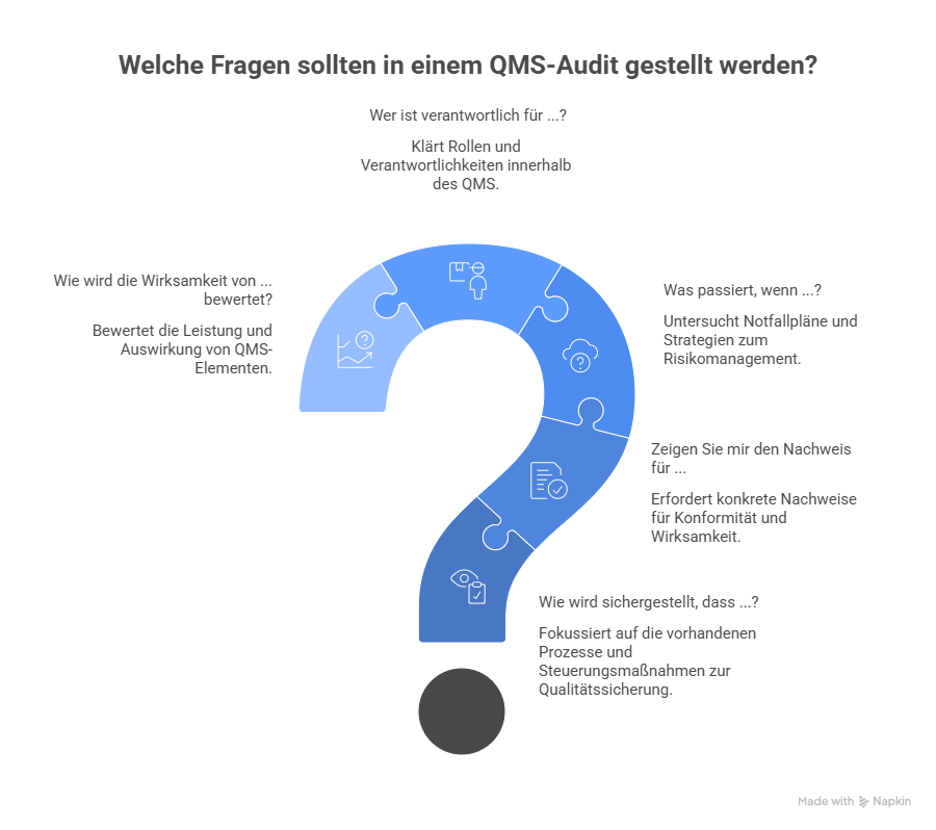
Typische Auditorfragen:
- Wie wird sichergestellt, dass…?
- Zeigen Sie mir den Nachweis für…
- Was passiert, wenn…?
- Wer ist verantwortlich für…?
- Wie wird die Wirksamkeit von… bewertet?
Aufbau der Managementbewertung
Die Managementbewertung führt alle QMS-relevanten Informationen zusammen und ermöglicht der obersten Leitung strategische Entscheidungen.Tagesordnung für die Managementbewertung:
- Rückblick auf frühere Bewertungen
- Status offener Maßnahmen
- Bewertung der Umsetzung
- Änderungen im Kontext
- Externe und interne Themen
- Änderungen bei interessierten Parteien
- Qualitätsleistung
- Erreichung der Qualitätsziele
- Kundenzufriedenheit und Reklamationen
- Prozessleistung und Kennzahlen
- Lieferantenleistung
- Ergebnisse interner und externer Audits
- Hauptfeststellungen
- Status der Korrekturmaßnahmen
- Ressourcensituation
- Personal
- Infrastruktur
- Schulungsbedarf
- Risiken und Chancen
- Bewertung der aktuellen Situation
- Anpassungsbedarf
- Verbesserungsmaßnahmen
- Vorschläge
- Entscheidungen
- Ausblick und Planung
- Ziele für die kommende Periode
- Ressourcenplanung
Teil 8: Der Zertifizierungsprozess
Die richtige Zertifizierungsstelle wählen
Zertifizierungsstellen müssen akkreditiert sein. In Deutschland ist die Deutsche Akkreditierungsstelle (DAkkS) die zuständige Behörde. Nur Zertifikate von akkreditierten Stellen sind international anerkannt.Auswahlkriterien:
- Akkreditierung für den relevanten Geltungsbereich
- Branchenerfahrung der Auditoren
- Regionale Präsenz (kürzere Anreise = niedrigere Kosten)
- Reputation und Referenzen
- Kosten und Vertragsbedingungen
- Flexibilität bei der Terminplanung
Typische Zertifizierungsstellen in der DACH-Region:
- TÜV SÜD, TÜV NORD, TÜV Rheinland, TÜV Hessen, TÜV Austria usw.
- DEKRA
- DQS
- Bureau Veritas
- SGS
- DNV
Stufe-1-Audit: Dokumentenprüfung
Das Stufe-1-Audit (auch “Voraudit” oder “Dokumentenprüfung”) ist der erste Teil der ISO-Zertifizierung. Es findet typischerweise 4–8 Wochen vor dem Stufe-2-Audit statt und kann vor Ort oder remote durchgeführt werden.Ziele des Stufe-1-Audits:
- Prüfung der QMS-Dokumentation auf Vollständigkeit und Normkonformität
- Bewertung der Standortbedingungen und standortspezifischen Aspekte
- Prüfung der Auditbereitschaft für Stufe 2
- Identifizierung potenzieller Problembereiche
Was wird geprüft?
- Qualitätspolitik und Qualitätsziele
- Prozessbeschreibungen und Dokumentation
- Ergebnisse interner Audits
- Protokolle der Managementbewertung
- Verfahren für Korrekturmaßnahmen
Mögliche Ergebnisse:
- Bereit für Stufe 2
- Bereit für Stufe 2 mit Hinweisen
- Stufe 2 erst nach Verbesserungen möglich
Stufe-2-Audit: Vor-Ort-Audit
Das Stufe-2-Audit ist das eigentliche Zertifizierungsaudit. Externe Auditoren prüfen vor Ort, ob das QMS wie dokumentiert implementiert ist und wirksam ist.Auditdauer:
Die Auditdauer hängt von Unternehmensgröße und Komplexität ab. Als Richtwert: für ein Unternehmen mit 20 Mitarbeitern ca. 2–3 Audittage, für 50 Mitarbeiter ca. 4–5 Audittage.Ablauf:
- Eröffnungsbesprechung
- Auditierung der Prozesse (Interviews, Dokumentenprüfung, Beobachtung)
- Prüfung von Nachweisen und Aufzeichnungen
- Zusammenfassung und Abschlussbesprechung
Was Auditoren sehen wollen:
- Aktive Umsetzung von Prozessen, nicht nur Papierarbeit
- Objektive Nachweise, dass Anforderungen erfüllt werden
- Mitarbeiter, die in ihren Aufgaben kundig und kompetent sind
- Ein wirksames System zur kontinuierlichen Verbesserung
- Nachgewiesenes Engagement der obersten Leitung
Typische Nichtkonformitäten und deren Vermeidung
Häufige Nichtkonformitäten:
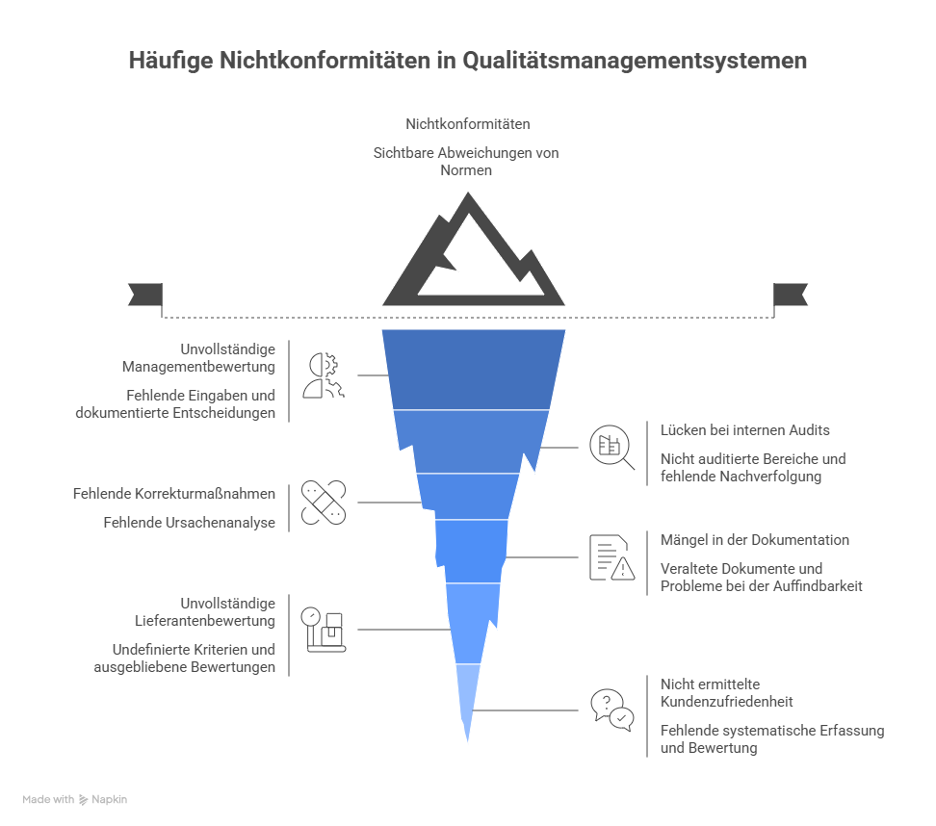
- Unvollständige Managementbewertung
- Nicht alle erforderlichen Eingaben wurden berücksichtigt
- Keine nachvollziehbaren Entscheidungen dokumentiert
- Lücken bei internen Audits
- Nicht alle Bereiche werden auditiert
- Auditoren nicht unabhängig
- Keine Nachverfolgung von Maßnahmen
- Fehlende Korrekturmaßnahmen
- Ursachenanalyse wurde nicht durchgeführt
- Wirksamkeit nicht bewertet
- Dokumentationsmängel
- Veraltete Dokumente im Umlauf
- Aufzeichnungen nicht auffindbar
- Fehlende Nachweise für Schulungen
- Unvollständige Lieferantenbewertung
- Kriterien nicht definiert
- Bewertungen nicht durchgeführt
- Kundenzufriedenheit wird nicht ermittelt
- Keine systematische Erfassung
- Ergebnisse nicht ausgewertet
Vermeidungsstrategien:
- Führen Sie vor dem Audit eine vollständige Selbstbewertung zur ISO-Konformität durch
- Verwenden Sie Checklisten basierend auf Normanforderungen
- Prüfen Sie alle Aufzeichnungen der letzten 12 Monate auf Vollständigkeit
- Bereiten Sie Mitarbeiter auf typische Auditorfragen vor
Teil 9: BAFA-Förderung im Detail
Voraussetzungen für die Förderung
Wer wird gefördert?
Das Förderprogramm richtet sich an kleine und mittlere Unternehmen (KMU) und Angehörige der freien Berufe, die folgende Kriterien erfüllen:- Weniger als 250 Mitarbeiter
- Jahresumsatz unter 50 Millionen Euro oder Bilanzsumme unter 43 Millionen Euro
- Sitz, Niederlassung oder Betriebsstätte in Deutschland
- Wirtschaftliche Tätigkeit
Was wird gefördert?
Förderfähige Leistungen umfassen strategische Beratungen zu wirtschaftlichen, finanziellen, personellen und organisatorischen Unternehmensfragen. Dies umfasst ausdrücklich Beratung zur Implementierung eines Qualitätsmanagementsystems. Nicht gefördert werden Leistungen, die überwiegend aus Rechts-, Versicherungs- oder Steuerberatung bestehen. Ebenfalls ausgeschlossen sind Gutachten, Studien oder Konzepte, die keine konkreten Handlungsempfehlungen liefern.Antragsprozess Schritt für Schritt
- Berater auswählen: Der Berater muss bei der BAFA registriert sein und eine gültige Berater-ID haben. Die Liste zugelassener Berater ist über die BAFA-Website verfügbar.
- Antrag online stellen: Der Förderantrag wird ausschließlich online über die BAFA-Antragsplattform gestellt. Es werden nur Unternehmensdaten und Informationen zur geplanten Beratung benötigt.
- Informationsschreiben abwarten: BAFA oder eine Leitstelle prüft den Antrag und informiert über das Ergebnis. Dieses Informationsschreiben erlaubt den Beginn der Beratung. Wichtig: Erst nach Erhalt dieses Schreibens darf der Beratungsvertrag abgeschlossen und die Beratung begonnen werden. Eine rückwirkende Förderung ist ausgeschlossen.
- Beratung durchführen: Die Beratung wird durchgeführt und resultiert in einem Beratungsbericht mit konkreten Handlungsempfehlungen.
- Verwendungsnachweis einreichen: Nach Abschluss der Beratung muss innerhalb von sechs Monaten der Verwendungsnachweis eingereicht werden. Dieser umfasst den Beratungsbericht, Rechnungen und Zahlungsnachweise, EU-KMU- und De-minimis-Erklärung sowie Fragebögen zu ESF-Plus-Grundsätzen.
- Auszahlung: Nach Prüfung des Verwendungsnachweises erfolgt die Auszahlung des Zuschusses.
BAFA-Zuschuss optimal für ISO 9001 Implementierung nutzen
Tipps für maximale Förderung:
Die Beratung sollte so geplant werden, dass förderfähige Kosten möglichst ausgeschöpft werden. Bei Beratungskosten von 3.500 Euro und einem Fördersatz von 80% beträgt der Eigenanteil nur 700 Euro. Da maximal zwei Beratungen pro Jahr gefördert werden können, kann ein größeres Projekt über mehrere Jahre verteilt werden. Beispielsweise könnte Jahr 1 Gap-Analyse und Konzeption, Jahr 2 Implementierungsunterstützung und Jahr 3 Auditvorbereitung abdecken. Für Unternehmen, die weniger als ein Jahr am Markt sind, ist vor der Antragstellung ein kostenloses Informationsgespräch mit einem regionalen Partner erforderlich.Teil 10: Nach der ISO-Zertifizierung
Überwachungsaudits: Was Sie erwartet
Nach erfolgreicher Zertifizierung folgen jährliche Überwachungsaudits. Diese sind kürzer als das Zertifizierungsaudit, prüfen aber die fortlaufende Konformität und Wirksamkeit des QMS.Was wird in Überwachungsaudits geprüft?
- Interne Audits und Managementbewertung
- Korrekturmaßnahmen seit dem letzten Audit
- Umgang mit Kundenreklamationen
- Wirksamkeit des QMS hinsichtlich Zielerreichung
- Fortschritt bei geplanten Verbesserungen
- Fortlaufende Steuerung der Kernprozesse
- Änderungen am QMS oder der Organisation
Kontinuierliche Verbesserung leben
Das Erlangen eines Zertifikats ist ein Meilenstein, aber kein Endpunkt. Die größte Herausforderung besteht darin, das QMS lebendig zu halten und kontinuierlich weiterzuentwickeln.Erfolgsfaktoren für ein lebendiges QMS:
- Regelmäßige Kennzahlenauswertung und Reaktion auf Abweichungen
- Aktive Nutzung des Korrekturmaßnahmenprozesses
- Einbindung der Mitarbeiter in Verbesserungsinitiativen
- Regelmäßige Überprüfung und Anpassung von Prozessen
- Fortlaufende Schulung und Kompetenzentwicklung
Warnsignale für ein “totes” QMS:
- Dokumentation wird nur unmittelbar vor Audits aktualisiert
- Korrekturmaßnahmen werden als bloße Formalität behandelt (“Abhak-Übungen”)
- Kennzahlen und Daten werden ignoriert oder nicht überwacht
- Managementbewertungen sind bürokratische Formalitäten ohne umsetzbare Ergebnisse
- Mitarbeiter kennen die Prozessbeschreibungen nicht
Typische Fehler nach der Zertifizierung
Fehler 1: Nachlässigkeit zwischen den Audits
Nach dem Zertifizierungsaudit kehrt der Alltag zurück und das QMS rückt in den Hintergrund. Das Ergebnis: Beim nächsten Überwachungsaudit fehlen Nachweise und Prozesse werden nicht mehr befolgt. Vermeidung: Etablieren Sie feste Routinen für QMS-Aufgaben (wöchentliche/monatliche Reviews), weisen Sie QMS-Verantwortlichkeiten klar zu.Fehler 2: Überfrachtung mit Dokumentation
Aus Angst vor Auditfeststellungen wird immer mehr dokumentiert. Das System wird bürokratisch und unpraktisch. Vermeidung: Hinterfragen Sie regelmäßig: Brauchen wir dieses Dokument wirklich? Wird es verwendet? Halten Sie die Dokumentation schlank.Fehler 3: Keine Weiterentwicklung
Das QMS wird als statisches System betrachtet, das einmal aufgebaut und dann nie mehr geändert wird. Vermeidung: Jährliche Überprüfung der Prozesse auf Aktualität und Verbesserungspotenzial. Benchmarking mit anderen Unternehmen.Erweiterung auf andere Managementsysteme
Die High Level Structure (HLS) der ISO-Managementsystemnormen ermöglicht eine einfache Integration weiterer Normen. Typische Erweiterungen für KMU im Maschinenbau sind:- ISO 14001 für Umweltmanagement
- ISO 45001 für Arbeits- und Gesundheitsschutz
- ISO 13485 für Medizinprodukte
Teil 11: DIY vs. Beratung – Die richtige Entscheidung treffen
Wann DIY funktioniert
Eine eigenständige Implementierung kann erfolgreich sein, wenn Erfahrung mit Managementsystemen bereits vorhanden ist (durch frühere Tätigkeiten, Schulungen), ausreichend Zeit für Einarbeitung und Umsetzung zur Verfügung steht (realistisch: mehrere Monate mit erheblichem Zeitaufwand), die Unternehmensstruktur überschaubar und klar ist, einfache Prozesse bestehen und die Bereitschaft da ist, aus Fehlern zu lernen und Verbesserungen vorzunehmen.Vorteile des DIY-Ansatzes:
- Tiefes Verständnis des eigenen Systems
- Reduzierte externe Beratungskosten
- Unabhängigkeit von Terminplänen Dritter
- Erhalt von Expertise und Wissen im Unternehmen
Risiken des DIY-Ansatzes:
- Verlängerte Projektlaufzeit durch Lernkurve
- Höheres Risiko von Fehlinterpretationen der Normanforderungen
- Mögliche Auditfeststellungen durch übersehene Regelungen
- Hohe Opportunitätskosten durch den erforderlichen Zeitaufwand der Mitarbeiter
Wann professionelle Unterstützung sinnvoll ist
Erwägen Sie professionelle Beratung, wenn Sie unter Druck durch Kundentermine oder Ausschreibungsfristen stehen. Es ist der effektivste Ansatz, wenn interne QM-Expertise fehlt, Prozesse komplex sind oder der Betrieb mehrere Standorte umfasst. Beratung ist auch die richtige Wahl, wenn Ihr Team vom Tagesgeschäft vollständig absorbiert ist oder wenn Sie einfach einen reibungslosen, problemlosen Weg zur Zertifizierung wünschen.Vorteile professioneller Unterstützung:
- Strukturiertes, effizientes Vorgehen
- Vermeidung typischer Fehler
- Erfahrung aus vielen Projekten
- Externer Blick auf blinde Flecken
- Zeitersparnis durch bewährte Vorlagen und Methoden
- Sicherheit durch Erfahrung mit Zertifizierungsaudits
- Deutlich reduzierter interner Aufwand
Der Hybridansatz
Viele kleine Unternehmen wählen einen Mittelweg: Bestimmte Phasen werden mit externer Unterstützung durchgeführt, andere eigenständig.Typische Aufteilung:
Mit Berater:
- Initiale Gap-Analyse (Ausgangspunkt und Umfang klären)
- Schulung interner Mitarbeiter
- Prüfung der erstellten Dokumentation
- Vorbereitung auf das Zertifizierungsaudit
Eigenständig:
- Erstellung der Prozessdokumentation
- Umsetzung im Tagesgeschäft
- Durchführung interner Audits (ggf. nach Schulung)
- Pflege und Weiterentwicklung des Systems
Den richtigen Partner finden
Wenn Sie sich für externe Unterstützung bei ISO-Konformität und Qualitätsmanagement-Implementierung entscheiden, stellen Sie sicher, dass der Berater akkreditiert und erfahren ist (BAFA-Zulassung als Mindeststandard nutzen). Er sollte relevante Branchenkenntnisse besitzen und einen pragmatischen Ansatz verfolgen, der übermäßige Bürokratie vermeidet. Prüfen Sie außerdem, ob seine Verfügbarkeit zu Ihrem Projektplan passt und ob die Chemie stimmt, da die Zusammenarbeit mehrere Monate dauern kann.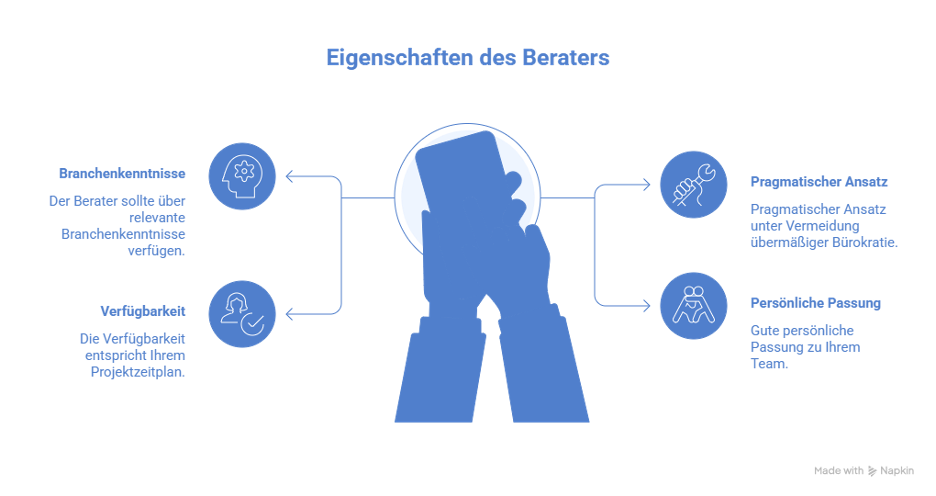
Fazit: Der Weg zur Zertifizierung ist machbar
Die ISO 9001 Zertifizierung ist ein erreichbares Ziel für KMU in der DACH-Region – unabhängig davon, ob der Weg eigenständig oder mit Unterstützung gegangen wird. Der Schlüssel liegt in realistischer Planung, konsequenter Umsetzung und dem Engagement der Geschäftsleitung. Dieser Leitfaden hat die wesentlichen Schritte beschrieben: von der Entscheidung über das Verständnis der Norm bis zur Zertifizierung und darüber hinaus. Wichtig ist, den ersten Schritt zu machen: die Norm erwerben und studieren, eine Gap-Analyse durchführen und einen realistischen Projektplan erstellen. Dann folgt die schrittweise Umsetzung in Richtung ISO-Konformität – nicht perfekt, aber konsequent. Ein gut implementiertes QMS ist keine Bürokratie, sondern ein Werkzeug für bessere Prozesse, zufriedenere Kunden und letztlich Geschäftserfolg.Über den Autor:
Jonathan Sternberg ist zertifizierter interner Auditor und externer Qualitätsmanagementbeauftragter mit Erfahrung in der Automobil-, Halbleiter-, Laseroptik- und Medizintechnikbranche. Mit Sternberg Consulting unterstützt er kleine und mittlere Unternehmen in der DACH-Region bei der Implementierung von ISO 9001, ISO 14001, ISO 45001 und ISO 13485.Bereit für den nächsten Schritt?
Wer den eigenständigen Weg wählt, findet in unserem Blog vertiefende Artikel zu jedem Normabschnitte. Wer professionelle Unterstützung bevorzugt, kann ein unverbindliches Erstgespräch vereinbaren. Als BAFA-zugelassener Berater unterstützt Sternberg Consulting Sie auch bei der Beantragung von Fördermitteln. Benötigen Sie Unterstützung bei der ISO 9001 Implementierung für KMU? Unsere Experten begleiten Sie strukturiert von der Planung bis zum erfolgreichen Zertifizierungsaudit.FAQs
Wie lange dauert die ISO 9001 Implementierung für ein kleines oder mittleres Unternehmen?
Die typische Projektdauer hängt von der Unternehmensgröße ab: Kleine Unternehmen mit weniger als 20 Mitarbeitern und einfacher Struktur benötigen in der Regel 3 bis 6 Monate. Mittlere Unternehmen mit 20 bis 100 Mitarbeitern sollten 6 bis 12 Monate einplanen. Bei komplexeren Strukturen oder zusätzlichen Anforderungen kann die Implementierung 12 bis 18 Monate dauern.
Gibt es finanzielle Förderung für die ISO 9001 Beratung von KMU in Deutschland?
Ja, das BAFA-Programm "Förderung unternehmerischen Know-hows" unterstützt KMU in Deutschland bei Beratungskosten. In den neuen Bundesländern werden bis zu 80% der Kosten (maximal 2.800 Euro) übernommen, in den alten Bundesländern bis zu 50% (maximal 1.750 Euro). Der Antrag muss vor Beginn der Beratung über die BAFA-Plattform gestellt werden, da eine rückwirkende Förderung ausgeschlossen ist.
Braucht man für ISO 9001:2015 noch ein QM-Handbuch?
Die ISO 9001:2015 fordert nicht mehr explizit ein QM-Handbuch. Dennoch ist die Erstellung eines Handbuchs sehr empfehlenswert, besonders für KMU, die das QMS eigenständig aufbauen. Ein strukturiertes Handbuch entlang der Normabschnitt 4 bis 10 hilft bei der Vollständigkeitsprüfung, erleichtert die Auditvorbereitung und dient als Referenz im Tagesgeschäft. Oft reichen 20 bis 40 Seiten aus.
Kann ein KMU die ISO 9001 Zertifizierung ohne externen Berater erreichen?
Grundsätzlich ja – mit dem richtigen Wissen, ausreichend Zeit und einem strukturierten Ansatz ist eine eigenständige Implementierung möglich. Allerdings erfordert die Norm die Durchführung interner Audits mit nachgewiesener Auditorkompetenz, sodass in der Regel eine Schulung zum internen Auditor notwendig ist. Ein erfahrener Berater kann den Prozess deutlich beschleunigen, das Fehlerrisiko minimieren und die Gesamtkosten durch höhere Effizienz oft sogar senken.


