


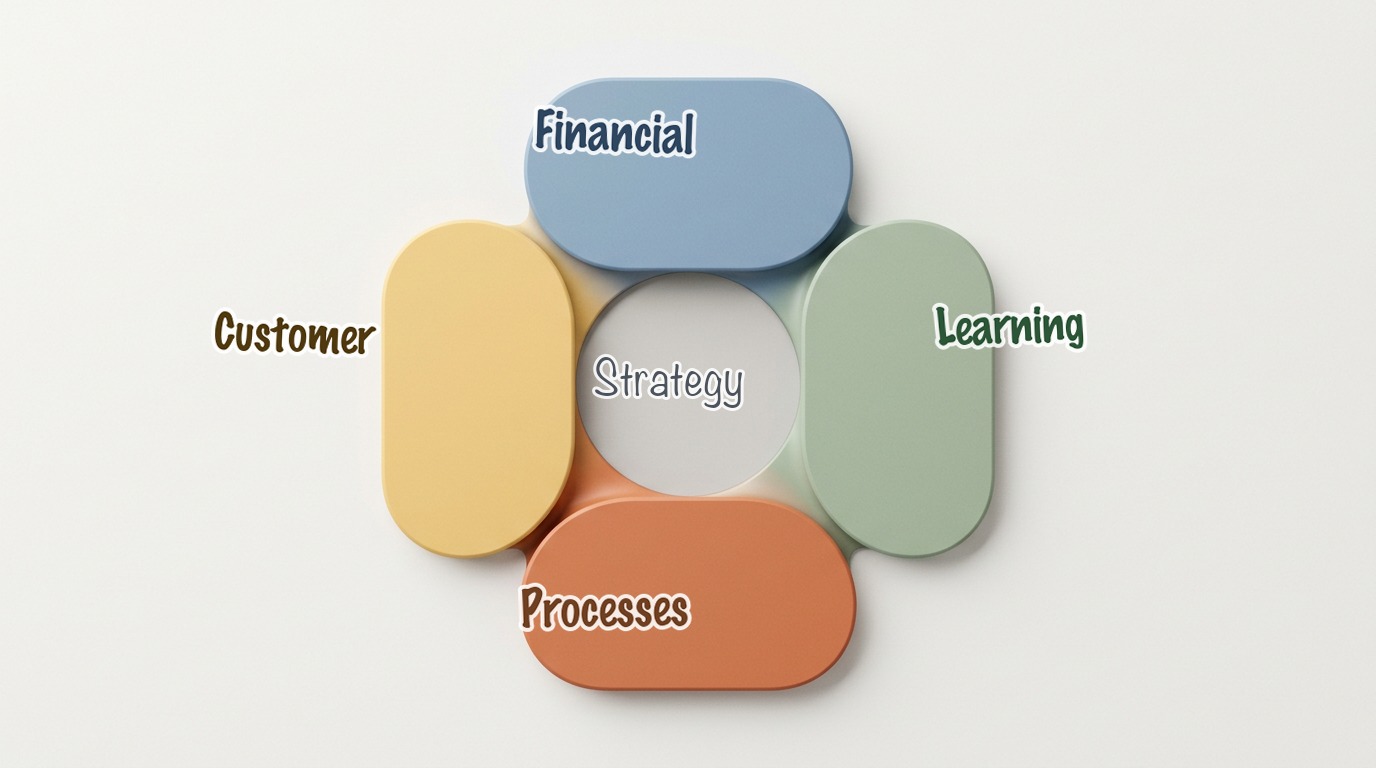
The balanced scorecard is a strategic planning and management system that helps leadership teams turn broad ambitions into measurable execution. Instead of relying only on financial reporting, it combines financial results with customer outcomes, internal process performance, and organizational capability building. Used well, it becomes a management rhythm rather than a reporting slide.
That matters because many organizations already have a strategy, a budget, and a long KPI list, but the parts do not connect. Teams track what is easy to count rather than what explains whether strategy is working. A balanced scorecard closes that gap by showing which capabilities drive process performance, which processes shape customer outcomes, and which customer outcomes eventually improve financial results.
“The scorecard is most useful when it forces leadership to choose what matters most, what will be reviewed regularly, and what actions will follow when performance drifts.”
What the Balanced Scorecard Actually Does
At a practical level, a balanced scorecard helps an organization answer four questions at the same time:
- What financial outcomes define success?
- What customer experience or market position do we need to achieve those outcomes?
- Which internal processes must perform reliably to support that customer promise?
- Which skills, systems, and behaviors do we need in order to keep improving?
This is why the method fits well with structured management systems. If your company already works with measurable quality objectives, a documented quality policy, or a formal review of risks and opportunities, the balanced scorecard gives those elements a strategic container and a cadence for review.
The Four Perspectives at a Glance
| Perspective | Main question | Typical indicators | Management risk if ignored |
|---|---|---|---|
| Financial | How do we create economic value? |
|
Teams stay busy without proving that strategy improves business results. |
| Customer | How do customers experience us? |
|
Customer churn rises while internal reporting still looks healthy. |
| Internal processes | Which processes must perform reliably? |
|
Bottlenecks, firefighting, and inconsistent delivery remain invisible until margins are damaged. |
| Learning and growth | What capabilities sustain improvement? |
|
The organization cannot scale, adapt, or improve strategy execution over time. |
Why Companies Struggle with Strategic Planning
Most scorecards fail for ordinary reasons rather than technical ones. Leadership teams either choose too many objectives, collect too many lagging indicators, or review the scorecard without making decisions. The result is a dashboard that looks impressive but has little influence on budgeting, staffing, priorities, or corrective action.
These failure patterns also show up in broader management systems. A company may define targets but fail to connect them with process ownership. It may run internal audits but not translate the findings into management priorities. It may analyze problems using methods such as Five Whys or 8D problem solving, yet still miss the bigger strategic pattern behind repeated issues.
Common Balanced Scorecard Mistakes
- Using the scorecard as a reporting archive instead of a management tool.
- Adding every available KPI rather than selecting a few measures that change decisions.
- Focusing on lagging results while ignoring capability-building indicators.
- Not assigning owners, review frequency, thresholds, and follow-up actions.
- Separating strategy reviews from budgeting, quality objectives, and operational priorities.
How to Build a Balanced Scorecard That Teams Will Actually Use
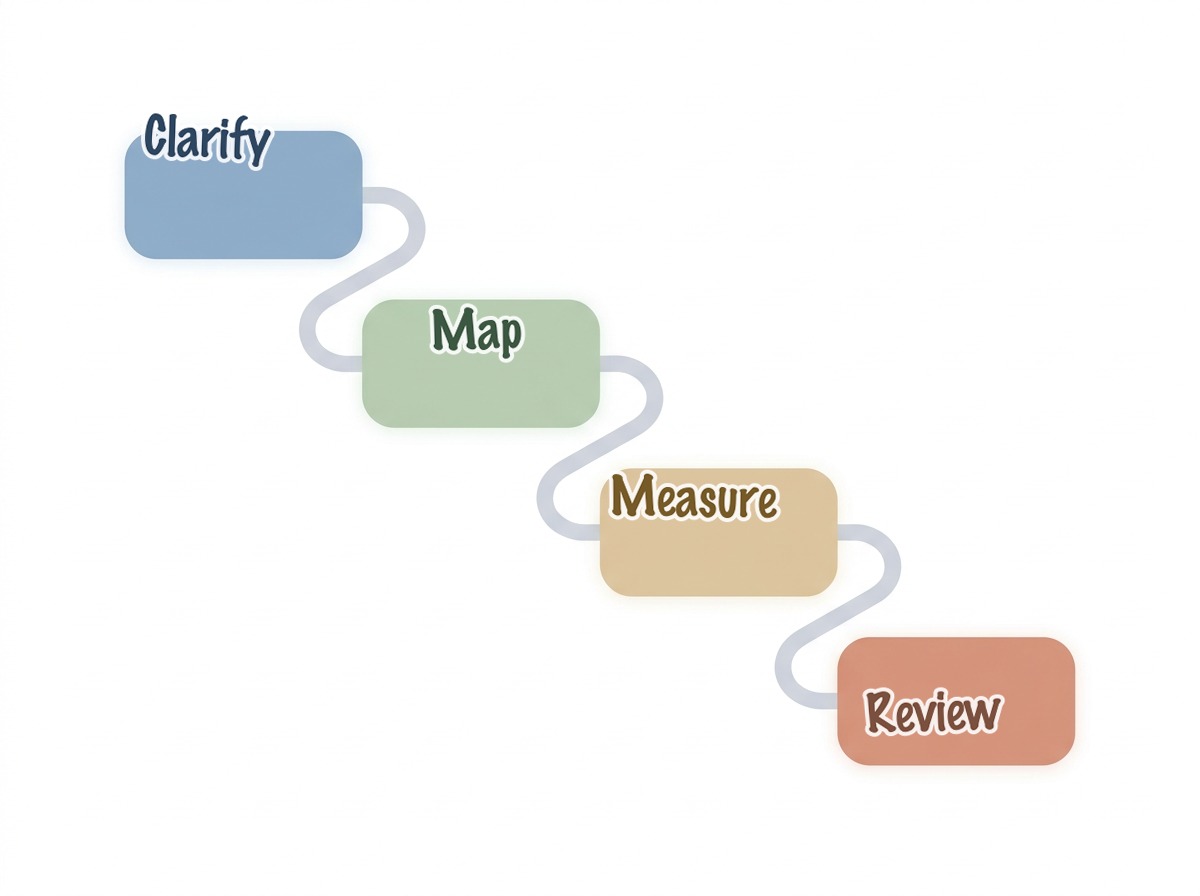
A good implementation usually moves through four stages. The order matters because the scorecard should reflect strategy logic before anyone starts debating chart design.
- Clarify the strategy. Define the strategic themes, target segments, expected outcomes, and time horizon. If the strategy is vague, the scorecard will be vague too.
- Build the strategy map. Show how learning and growth enable process excellence, how processes create customer value, and how customer outcomes drive financial performance.
- Select a limited KPI set. Every objective needs only a small number of indicators, a clear formula, an owner, a data source, and a review frequency.
- Run management reviews. Monthly or quarterly reviews should examine trends, challenge assumptions, and trigger actions when targets are missed.
Organizations that already work with structured reviews, such as internal audit programs or management system performance reviews, can usually embed the scorecard without creating a parallel bureaucracy. The key is to align the review cycle with existing governance instead of layering another meeting series on top.
Example Scorecard for a Mid-Sized Manufacturing Business
The example below shows how a medium-sized manufacturer might translate strategy into a compact scorecard. The goal is not to copy the exact KPIs, but to see how each perspective supports the next one.
| Perspective | Strategic objective | Example KPI | Target direction |
|---|---|---|---|
| Financial | Improve profitable growth | Contribution margin on strategic product lines | Increase |
| Customer | Become the preferred supplier for priority accounts | On-time delivery and repeat order rate | Increase |
| Internal processes | Reduce disruption in order fulfillment | Schedule adherence and rework rate | Improve consistency |
| Learning and growth | Strengthen problem-solving and digital reporting capability | Supervisor training completion and dashboard adoption | Increase |
Notice that the internal process measures are not random operational KPIs. They are chosen because they influence delivery reliability and repeat business. That cause-and-effect thinking is what separates a balanced scorecard from a generic dashboard.
How to Choose Better Balanced Scorecard Measures
One of the hardest parts of scorecard design is choosing measures that are both meaningful and manageable. Leadership teams often start with what is already available in reporting systems, but that usually creates a bias toward lagging indicators. Revenue, profit, complaint count, and overdue actions matter, but they tell you what has already happened. A strong scorecard also includes leading measures that can change management behavior before the quarter is lost.
A practical rule is to test every KPI against four questions:
- Does this measure support a clearly defined strategic objective?
- Can leadership influence the result through decisions or action?
- Is the data reliable enough to review without endless debate?
- Will this measure prompt action if performance deteriorates?
If the answer to several of those questions is no, the KPI probably belongs in an operational dashboard rather than a leadership scorecard. This distinction is important. Executive teams need metrics that support prioritization, resource allocation, and escalation. They do not need every underlying operational data point in the same review pack.
| Measure type | What it tells leadership | Example |
|---|---|---|
| Lagging indicator | Whether the result has already been achieved | Quarterly margin, customer retention, audit findings closed |
| Leading indicator | Whether the system is moving toward the intended result | Training completion, schedule adherence, proposal turnaround time |
| Diagnostic indicator | Why a result is drifting and where management attention is needed | Rework by product family, complaint category trend, late purchase orders |
In practice, many of the strongest scorecards blend these types. Financial outcomes confirm whether the strategy is paying off. Customer and process indicators explain the operational mechanism behind those results. Learning and growth measures show whether the organization is building the capability required to sustain performance.
Governance, Ownership, and Review Discipline
Even well-chosen measures lose value when governance is weak. The scorecard needs explicit ownership. Someone must be responsible for the metric definition, someone must be accountable for performance, and leadership must decide how often the measure is reviewed and what type of escalation is expected when targets are missed.
This is where many companies underestimate the management effort required. The scorecard itself is simple. The discipline around it is not. Review meetings should focus on exceptions, trends, and countermeasures rather than reading numbers aloud. When a metric is off track, the discussion should quickly move to root causes, actions, owners, due dates, and follow-up verification.
A balanced scorecard review should answer three questions: what changed, why it changed, and what leadership is going to do next.
For SMEs, a lightweight governance model is usually enough:
- One executive sponsor who owns the overall scorecard logic.
- One owner per objective or KPI cluster.
- A monthly or quarterly review schedule fixed on the leadership calendar.
- A short action log that is checked at the start of the next review.
- Periodic revision of the scorecard when strategy, product mix, or market conditions change.
Companies that already maintain documented actions from audits, management reviews, or continuous improvement programs can often reuse those workflows. The point is not to invent a second management system. The point is to make strategy visible in the routines the business already runs.
Checklist for a Useful Balanced Scorecard Review
Balanced Scorecard vs KPI Dashboard vs OKRs
These terms are often mixed together, but they do different jobs.
| Tool | Primary purpose | Best use case |
|---|---|---|
| Balanced scorecard | Translate strategy into linked objectives and measures across perspectives. | Leadership alignment and recurring strategic review. |
| KPI dashboard | Monitor performance data quickly. | Operational tracking and day-to-day visibility. |
| OKRs | Drive focused short-cycle execution around stretch objectives. | Team-level execution in dynamic growth environments. |
In many companies, these methods can complement one another. A balanced scorecard can define the strategic logic, operational dashboards can provide daily visibility, and OKRs can help teams drive improvement projects or market initiatives in shorter cycles.
Where It Fits with Quality Management and Continuous Improvement
For SMEs and regulated businesses, the balanced scorecard is especially useful when leadership wants stronger links between strategy, compliance, and operational performance. It works well alongside management system disciplines such as documented objectives, process monitoring, internal audits, and improvement action tracking.
For example, if you are already working on a documented process landscape or a more structured lean management approach, the scorecard helps decide which measures leadership should see regularly and which process changes actually support strategic outcomes.
How Sternberg Consulting Implements Balanced Scorecards
We help client businesses turn strategy into a manageable scorecard by facilitating objective selection, mapping cause-and-effect logic, defining useful KPIs, and embedding the review cycle into existing management routines. For organizations that already run ISO-based systems, we connect the scorecard with quality objectives, process indicators, internal audits, and management review so leadership gets one coherent picture instead of disconnected reports. If you want support designing or cleaning up a balanced scorecard for your business, contact us.
Frequently Asked Questions
What is the main purpose of a balanced scorecard?
Its main purpose is to translate strategy into a small set of linked objectives and performance measures. The method helps leadership teams see whether capabilities, processes, customer outcomes, and financial results support one another.
How many KPIs should a balanced scorecard include?
There is no universal number, but most organizations benefit from restraint. A compact set of high-value measures is more useful than a large dashboard that nobody reviews closely.
How often should the scorecard be reviewed?
Monthly or quarterly reviews are common. The right frequency depends on how quickly the business changes, how reliable the data is, and whether the leadership team is prepared to act on what it sees.
Is the balanced scorecard only for large companies?
No. SMEs often benefit even more because the framework helps them focus scarce management attention on a few priorities and avoid fragmented reporting.


